


ISO 27001 Lead Auditor Training Course Content
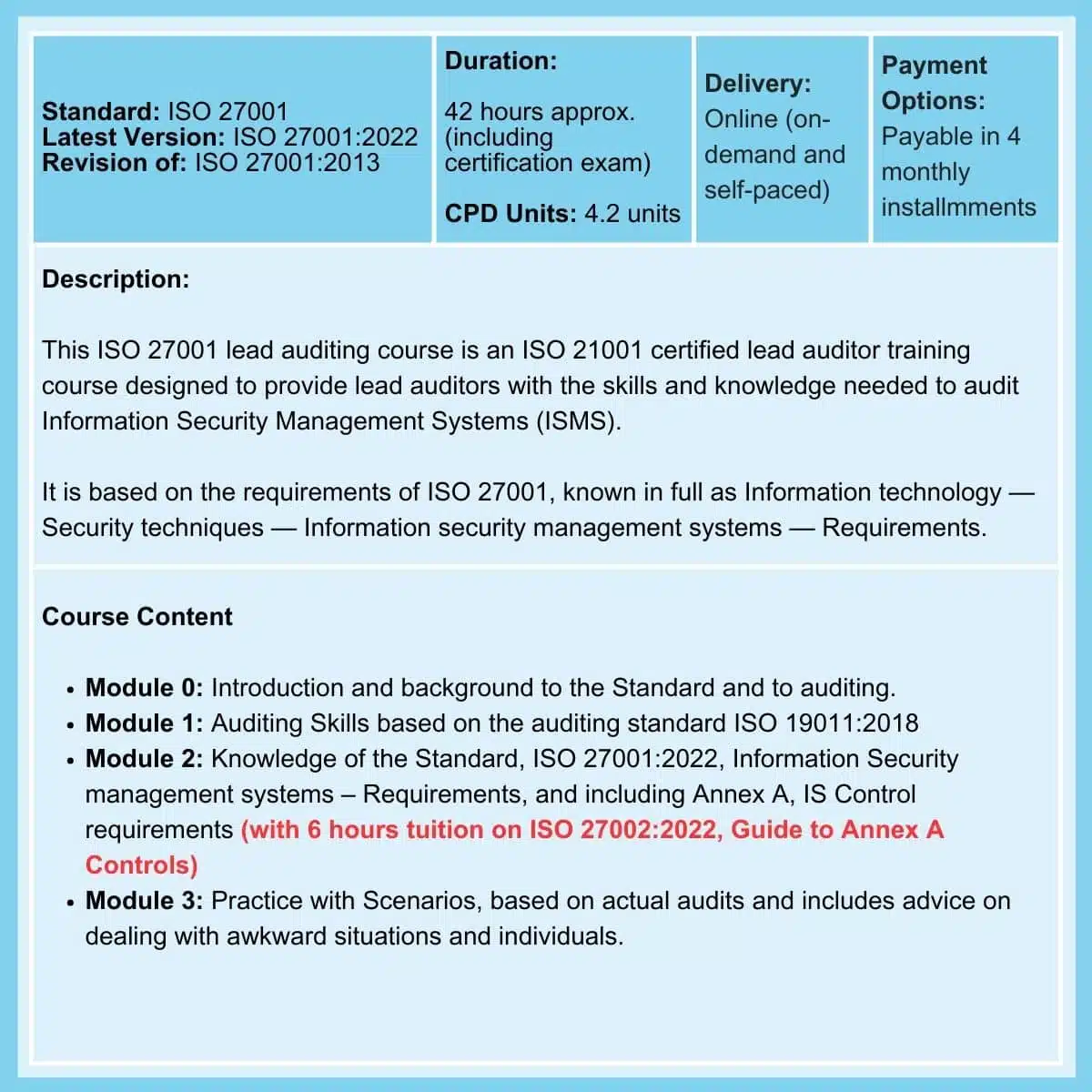
Be an internationally-certified Lead Auditor with our ISO 27001 Lead Auditor Training Course.
This course is for those wishing to participate in Certification Body and Registration Body auditing for Information Security Management System Requirements.
It provides you with the Auditing Skills, the Knowledge of the Standard (including Annex A – Information Security Controls) and the practical application of that knowledge with Audit Scenarios to enable you, as Audit Team Leader, to undertake and manage Certification Audits.
Who should enroll in this ISO 27001 Lead Auditor Course?
This ISO 27001 Lead Auditor Training Course is for:
- Prospective ISMS Consultants
- Business managers
- Compliance managers
- Supply Chain and Procurement managers
- Business Continuity managers
- IT managers
- Quality managers
- Project managers
- Emergency Planners
- Information Security managers
- ISO 22301 or ISO 27001 internal audit programme managers
- IT and other staff, including HR, legal, and business users.
- Risk managers
- Operations managers
- Those who wish to improve their career prospects
What will I learn from this ISO 27001 Lead Auditor Course?
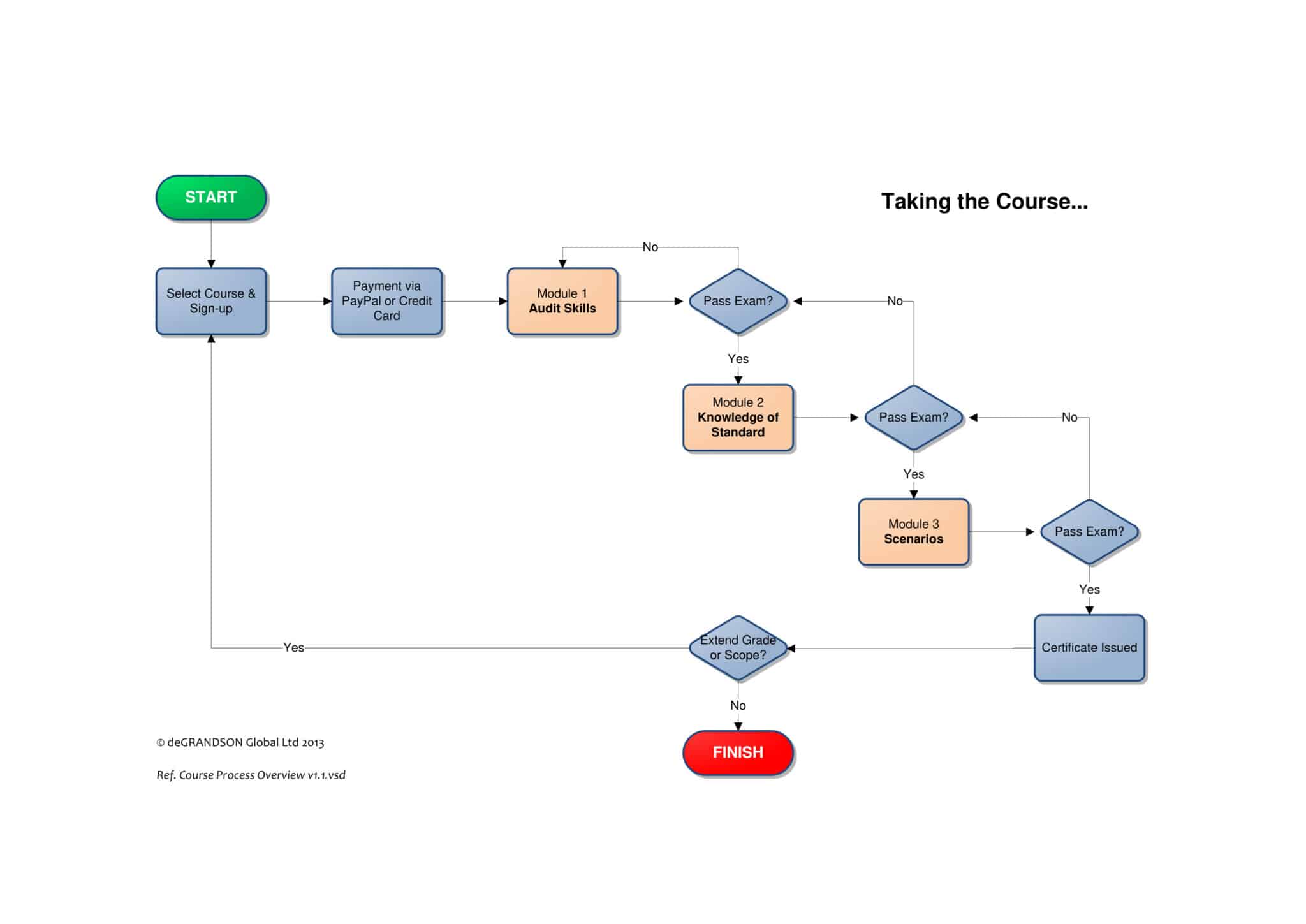
This comprehensive ISO 27001 Lead Auditor Training Course is divided into four Modules:
- Module 0: Introduction and background to the Standard and to auditing
Introduces ISO 27001 and the role of lead auditors in planning, executing, and reporting certification audits of information security management systems (ISMS). Participants learn how lead auditors guide audit teams, assess risk, and verify organizational compliance with information security policies and controls. - Module 1: Auditing Skills based on the auditing standard ISO 19011
Focuses on lead auditor competencies for ISO 27001 certification audits, emphasizing leadership, risk-based audit planning, and evaluation of ISMS effectiveness. Participants develop skills to direct audit teams, assess evidence, and ensure organizational adherence to information security standards.- Auditing Skills – Build advanced skills for leading audits, including evaluating evidence, conducting control testing, and assessing overall ISMS effectiveness. Examples include reviewing incident response processes and verifying the implementation of security controls.
- Terms and definitions – Learn ISO 27001 and auditing terminology relevant to certification audits. Examples include nonconformity, audit finding, and ISMS scope.
- Principles of auditing – Explore principles guiding lead auditors, such as objectivity, independence, and risk-based evaluation of information security controls.
- Auditor skills – Develop leadership, communication, and analytical skills to manage audit teams and report ISO 27001 compliance findings.
- Managing an audit programme – Learn to plan and oversee audit schedules, prioritize high-risk areas, and ensure ISMS compliance across the organization.
- Audit Team Leadership – Guide audit teams, delegate responsibilities, and ensure coordinated evaluation of information security controls and risk mitigation.
- Overview of Audit activities – Understand the full certification audit lifecycle, including planning, fieldwork, evidence verification, and reporting on ISMS compliance.
- Audit activities – Step 1 – Initiate audits by defining scope, objectives, and criteria for ISO 27001 certification. Examples include reviewing policies, ISMS documentation, and organizational risk registers.
- Audit activities – Step 2 – Plan and prepare for fieldwork, including resource allocation and evaluation of high-risk information security areas.
- Audit activities – Step 3 – Lead the audit team during fieldwork, including interviews, process observation, and verification of controls.
- Audit activities – Step 4 – Identify nonconformities, control gaps, and opportunities for ISMS improvement. Examples include access control failures or incomplete risk treatment plans.
- Audit activities – Step 5 – Report audit findings to senior management and certification bodies, ensuring accurate evaluation of information security compliance.
- Audit activities – Step 6 – Oversee corrective action verification and follow-up to confirm ISO 27001 compliance and ISMS effectiveness.
- FAQs about Auditing – Address common challenges in leading ISO 27001 audits, including managing difficult stakeholders and resolving discrepancies in ISMS evidence.
- Online Module Examination – Test knowledge of lead auditor responsibilities, ISMS evaluation, and ISO 27001 certification audit techniques.
- Module 2: Knowledge of the Standard, ISO 27001:2022, Information Security Management Systems requirements - Provides comprehensive coverage of ISO 27001:2022 clauses, focusing on how lead auditors assess ISMS implementation and information security effectiveness. Examples include reviewing risk assessment methodologies, verifying control implementation, and evaluating management oversight.
- Introduction to ISO 27001:2022 – Overview of the standard from a lead auditor perspective, emphasizing assessment of ISMS compliance and information security performance.
- Terms & Definitions – ISO 27001 – Understand ISO 27001 terms crucial for lead auditors, including control objectives, ISMS scope, and risk treatment.
- Fundamentals of Information Security Management Systems (ISMS) – Examine ISMS principles, processes, and structures that lead auditors verify during certification audits. Examples include evaluating policy enforcement, access control, and data protection measures.
- Some Key aspects of ISMS Auditing – Focus on risk-based evaluation, control effectiveness, and verification of ISO 27001 compliance. Auditors review evidence of information security monitoring, incident handling, and policy implementation.
- Structure & content of ISO 27001:2022 – Navigate clauses and annexes to identify areas for lead auditor evaluation, ensuring ISMS compliance.
- Parts 1, 2 & 3 – Review scope, references, and normative requirements from a certification audit viewpoint. Examples include verifying compliance with regulatory obligations and organizational policies.
- Part 4: Context of the organisation – Assess internal and external factors impacting information security and ISMS performance. Lead auditors evaluate how organizational context influences risk management and security objectives.
- Part 5: Leadership – Examine top management roles in ISMS governance and ISO 27001 compliance. Auditors check leadership engagement, policy approvals, and resource allocation.
- Part 6: Planning for the ISMS – Verify risk assessment procedures, information security objectives, and planning processes. Examples include reviewing risk registers, mitigation strategies, implementation of Annex A Controls, and alignment with ISO 27001 requirements.
- Information Security Risk Assessment – Lead auditors evaluate the identification, estimation, and prioritization of information security risks within the ISMS.
- Guidance to Risk Analysis – Review methods used by the organization to analyze risks and determine control effectiveness.
- Risk Identification – Verify that all relevant threats and vulnerabilities are documented and addressed in the ISMS.
- Risk Estimation – Evaluate the organization’s assessment of risk likelihood and impact, ensuring proper risk prioritization.
- Risk Evaluation – Check that risk treatment decisions align with ISO 27001 compliance and information security objectives.
- Information Security Risk Treatment – Assess implementation of controls to mitigate risks in the ISMS, including encryption, access management, and monitoring procedures.
- Information Security Objectives and planning to achieve them – Verify that objectives are measurable, achievable, and effectively integrated into ISMS operations.
- Part 7: Support – Examine ISMS resources, competence, awareness, and documentation. Lead auditors verify training records, documented procedures, and evidence of information security awareness.
- Part 8: Operation – Review operational processes to ensure information security controls are effectively applied in the ISMS. Examples include auditing system access, network security, and incident response workflows.
- Part 9: Performance evaluation – Verify measurement, monitoring, and reporting of ISMS effectiveness and information security performance. Auditors check KPI data, audit trails, and management reviews.
- Part 10: Improvement – Evaluate incident management plus corrective and preventive actions to strengthen ISMS and maintain ISO 27001 compliance.
- Advanced aspects of ISMS Auditing – Explore complex audit scenarios, control interactions, and risk evaluation techniques for lead auditors.
- FAQs about the Standard – Answer typical questions encountered in ISO 27001 certification audits, including control verification, compliance interpretation, and ISMS assessment.
- ISO 27002:2022, Information security, cybersecurity and privacy protection — Information security controls (5 lessons) – Review detailed security controls and their evaluation during certification audits. Examples include access control, cryptography, and network monitoring.
- ISO 27006:2015/Amd 1 2020, Security Techniques – Requirements for IS Certification Bodies – Understand certification body requirements and auditing expectations from a lead auditor perspective.
- Online Module Examination – Test knowledge of ISO 27001 auditing, ISMS verification, and information security control assessment.
- Module 3: Practice with Scenarios, based on actual audits, and includes advice on dealing with awkward situations and individuals
Provides scenario-based exercises for ISO 27001 certification audits, emphasizing lead auditor decision-making and team management. Examples include evaluating risk treatment plans, auditing ISMS processes, and handling nonconformities in challenging audit situations.- Audit Scenarios – Internal Auditor – Practice audits for verification of ISO 27001 controls and ISMS implementation, focusing on evidence collection and control assessment.
- More Audit Scenarios – Lead Implementers – Learn to coordinate audit findings with implementers while observing information security objectives.
- Yet more Audit Scenarios – Lead Auditors – Simulated certification audits emphasize leadership, team coordination, and evaluation of ISMS effectiveness in information security management.
- FAQs about the Auditing Experience – Discuss challenges that lead auditors face, including interpreting ISO 27001 requirements, managing audit teams, and verifying ISMS controls.
- Online Final Examination – Assess overall competence in leading ISO 27001 audits, evaluating ISMS, and verifying information security compliance.
What materials are included in this ISO 27001 Lead Auditor Course?
The course materials for this ISO 27001 Lead Auditor Training Course include:
- Diagram: Auditor Certification Process
- Diagram: 6-Stage Audit Process
- Sample Code of Ethics
- Management of an Audit Programme
- Audit Plan example
- Audit Work Order example
- Nonconformity Report example
- Documented information in ISO 27001
- EU GDPR fulltext
- Note: Information Assets
- Information security risk management process
- Information security risk treatment activity
- Chart of ISO 27001 Internal and External COTO Issues
- Stage 1 ISO 27001 Checklist of Critical Issues
- Stage 1 ISO 27001 Lead Auditor Checklist
- Sample Info Assets, SoA Risk Assessments and Controls
- Sample Statement of Applicability
- Workbook for Annex A (SoA) Evidence recording
How is this ISO 27001 Lead Auditor Course delivered?
The ISO 27001 Lead Auditor Training Course is delivered online from our Learning Management System (LMS), which is provided and maintained by Inquisiq, the Award-winning Learning Management System.
All Lessons have a full resume and scaling capabilities. This means, for example, you can:
- Start a Lesson at work on your Work Station running on Windows 8.1,
- Continue the Lesson on the train home on your iPad running on iOS 11 and,
- Complete the Lesson at home on your Notebook PC running on Windows 10.
Are there any prequalifications to enroll in this ISO 27001 Lead Auditor Course?
The minimum of a Secondary School Certificate (such as a High School Diploma, Baccalaureate or similar National Vocational Qualification) combined with 5 years’ work experience, with 2 at managerial/supervisory level, is recommended.
You do not have to provide us with any evidence of your qualifications and experience. However, if you do not meet these requirements, you can expect to struggle with the Course.
Related Courses
Course Author

Dr John FitzGerald graduated with a 1st class honours degree in chemistry and a PhD in synthetic organic chemistry. He worked for 15 years in the manufacturing industry, then as a trainer and consultant in the UK and Ireland before founding deGRANDSON Global in 2009.
He serves as the company Director and course developer while occasionally working as a Lead Auditor on ISO 9001, ISO 13485, ISO 14001, ISO 27001, ISO 45001, and ISO 55001 audits for an accredited certification body (CAB).




Our Certification

deGRANDSON Global has three university-grade management system certification including ISO 21001, Educational Organizational Management System; ISO 29993, Learning Services outside formal Education; and ISO 29994, Learning Services – additional requirements for Distance Learning.
Enrollment, Training, and Certification Process
Group Discount

Get 10, 15, and 25% discount when you enroll 3, 10, 20 or more people.
Free Gap Analysis Tool
Identify systems or process gaps in your management system that can be improved with our ISO 13485 Gap Analysis tool.
Sample Learner Certificate

deGRANDSON Global certificates issued to learners who successfully completed the training and passed the certification exam come with QR codes that can be shared on online profiles to instantly verify qualification to prospective clients or employers.