Frequently Asked Questions About ISO 19011
How is ISO 19011 Training Different from Sector-specific ISO Auditor Training?
Understanding an ISO standard is not the same as being able to audit it. Many professionals can recite the requirements of ISO 9001, ISO 14001, or ISO 27001. Still, you need to know how to evaluate whether those requirements are effectively implemented, gather objective evidence, engage with auditees, and present findings in a clear and constructive way.
ISO 19011 training focuses on building these practical auditing skills. It shifts the emphasis from theoretical knowledge of a standard’s clauses to the hands-on techniques of auditing.
Because ISO 19011 courses are not tied to one discipline, they:
- Build a transferable skill set that auditors can apply across multiple ISO standards, making it easier to maintain and demonstrate auditor competence,
- Help professionals in niche fields (for example, food safety under ISO 22000 or energy under ISO 50001) bridge gaps where standard-specific auditor training may be limited or unavailable,
- Let auditors combine knowledge of a particular standard (e.g., ISO 27001 controls) with universal auditing techniques, so assessments are both technically accurate and methodologically sound while opening up opportunities to work confidently in different industries
How is ISO 19011 Applied to Different ISO Management System Standards?
ISO 19011 provides a common framework for auditing across various ISO management system standards. Its principles and methods can be adapted to suit different types of systems, ensuring consistent, effective, and objective audits. Here’s how ISO 19011 is applied to each major standard:
- ISO 22000 (Food Safety Management System) & ISO 50001 (Energy Management System): Where dedicated auditor courses are less common, ISO 19011 acts as the practical bridge between standard knowledge and auditing practice.
What Key Skills and Knowledge Will You Get from ISO 19011 Training
ISO 19011 training isn’t just about understanding audit theory — it’s about building the skills you’ll actually use in real audits. Below are the key areas where you’ll strengthen your abilities and gain practical knowledge.
- Audit Planning & Risk-Based Thinking – Learn how to scope audits, prioritize risks, and prepare effective audit plans for complex standards like ISO 27001 (information security) or ISO 50001 (energy management), where risks vary widely.
- Communication & Interview Techniques – Master questioning, listening, and observation skills that allow you to draw out evidence from auditees. These skills are especially critical in ISO 45001 (health & safety) and ISO 13485 (medical devices), where practical, on-the-ground knowledge must be tested against documented systems.
- Objective Evidence & Findings – Gain the ability to tell the difference between casual comments and proof you can verify. This kind of audit evidence evaluation is key in ISO 17025 (laboratory competence) or ISO 22000 (food safety), where accuracy and traceability are a must.
- Nonconformity Reporting & Corrective Action – Learn to write findings clearly and link them back to requirements so organizations can act on them. Along the way, you’ll also build skills in nonconformity management and the corrective action process, which help teams fix problems in a way that lasts.
- Audit Ethics & Professional Conduct – Develop integrity, impartiality, and sound judgment — especially when working with suppliers or leading cross-functional teams. Good ethics go hand in hand with strong audit reporting skills, making sure results are explained clearly and fairly.
- Team Leadership & Program Management (Lead Auditor level) – Build the ability to coordinate teams, assign responsibilities, and manage complex multi-site or multi-standard audits.
Which is more cost-effective: ISO 19011 Training or Sector-specific Training?
ISO 19011 training offers a budget-friendly entry into auditing for both individuals and organizations.
Unlike sector-specific programs such as ISO 9001 or ISO 13485, which demand deeper technical study and higher fees, ISO 19011 focuses on universal audit principles and techniques. This makes it faster, more affordable, and highly transferable across different standards.
By mastering core auditing skills—planning, conducting, reporting, and follow-up—learners build a foundation that applies to many systems, from ISO 14001 to ISO 27001.
For individuals, ISO 19011 training boosts confidence and credibility before committing to specialized auditor training. For organizations, it cuts training costs by creating a shared skill base, with the option to upskill select staff in sector-specific standards later.
Is ISO 19011 Training Alone Enough to Audit Management Systems?
ISO 19011 training builds core auditing skills—planning, conducting, and reporting—that are often enough for internal or supplier audits, especially in organizations working with less common standards where sector-specific courses are not available.
For widely adopted standards like ISO 9001, ISO 13485, or ISO 27001, however, ISO 19011 works best as a complement. It develops auditing techniques, while the sector-specific course provides the technical requirements. Together, they meet the ISO auditor qualifications and ISO certification requirements expected by employers and certification bodies.
How does ISO 19011 Complement Sector-Specific Training?
ISO 19011 provides the auditing framework for all management system standards, while standards like ISO 9001, ISO 13485, or ISO 27001 supply the technical requirements.
Many learners take ISO 19011 first to build a foundation in audit best practices, making it easier to apply sector-specific requirements in structured audits. Others study it alongside sector-specific training, strengthening both technical knowledge and audit planning and execution.
In either case, ISO 19011 complements—not replaces—sector-specific courses, ensuring auditors are technically informed and methodologically skilled.
Is ISO 19011 Training Internationally Recognized?
ISO 19011 training is based on the internationally recognized auditing guideline used across all management system standards.
For internal auditors, this training is widely accepted as evidence of competence, particularly when paired with knowledge of the standard being audited, such as ISO 9001 or ISO 45001.
For those aiming at certification body roles, ISO 19011 training is seen as a vital stepping stone, though it must usually be combined with sector-specific Lead Auditor training to meet formal accreditation requirements.
Do deGRANDSON’s ISO 19011 courses have IRCA or Exemplar Approval?
deGRANDSON courses are certified to ISO 21001 rather than IRCA or Exemplar. This is because ISO 21001 provides strict, independently audited assurance of both the learning services and the management of the educational organization.
Unlike IRCA or Exemplar approvals, which function mainly as badges with limited international recognition and minimal ongoing monitoring, ISO 21001 requires continual evaluation of curricula, learning outcomes, and organizational processes.
Are deGRANDSON’s ISO 19011 Courses Certified?
deGRANDSON’s ISO 19011 training is delivered under a globally recognized educational framework. Each course is certified to international standards, including:
- ISO 21001:2018 – Educational Organizations Management Systems
- ISO 29993:2017 – Learning Services Outside Formal Education
- ISO 29994:2021 – Additional Requirements for Distance Learning
For participants, this certification offers several key benefits:
- Recognition by Employers and Certification Bodies: Your course is an accredited training program, backed by independent international standards. This gives your certificate credibility and makes it a globally recognized auditor qualification in the professional market.
- Consistency and Trust: Every course module is designed and delivered according to an educational management system that has been externally audited and approved, ensuring a reliable and high-quality learning experience.
- Confidence in Online Learning: With ISO 29993 and ISO 29994, our distance learning approach delivers effective, transparent, and engaging outcomes, making your certificate a respected professional auditor credential.
Choosing a deGRANDSON course means your qualification is more than a certificate — it is a credential supported by ISO 21001, the highest international benchmarks in education, helping you stand out to employers, certification bodies, and consulting clients.
Are the ISO 19011 courses fully online and self-paced, or are there fixed schedules I need to follow?
They are fully online, browser-based, and self-paced — no downloads or special software required. You can study on any desktop, tablet, or mobile device, at the time that best suits you.
How long is the validity of your ISO Consultant certificates?
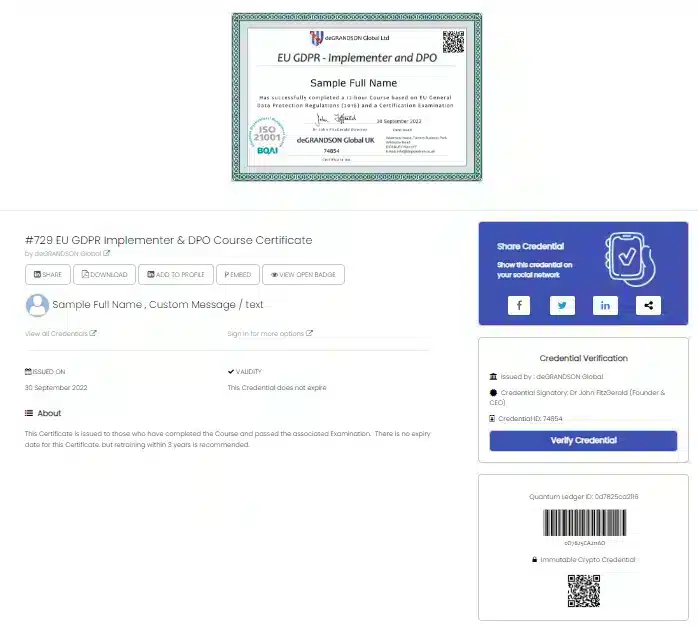
A Certificate from deGRANDSON’s ISO 19011 courses is valid indefinitely; there is no expiry date.
Why do you have a QR code on your ISO 19011 certificates?
A QR Code on your certificate ensures instant verification of your qualification. You can upload it to LinkedIn for employers, add it to business cards, or show it during client meetings. They provide real-time, tamper-proof proof of certification, giving diploma holders greater trust and professional credibility.


 ISO 19011