ISO 45001 is an internationally recognized standard that sets out the requirements for an Occupational Health and Safety Management System (OHSMS). It provides a structured framework for identifying hazards, managing OH&S risks, and improving workplace safety performance.
The standard replaced OHSAS 18001 and aligns OH&S management with modern management system principles, including leadership accountability, worker participation, and risk-based thinking.
ISO 45001 is also the benchmark used by certification bodies when assessing an organization’s readiness for certification. Auditors trained on ISO 45001 evaluate how effectively an organization’s system controls risk in practice—not just whether procedures exist on paper.
Beyond preventing injury and ill health, ISO 45001 enables organizations to demonstrate effective risk control, legal compliance, and continual improvement—elements that are directly evaluated during internal and external audits.
For organizations pursuing certification, ISO 45001 defines the criteria auditors use to assess whether safety processes are effective, implemented, and capable of sustaining safe operations over time.
What is an Occupational Health and Safety Management System?
An Occupational Health & Safety Management System (OHSMS) is a structured framework that helps organizations identify, manage, and reduce workplace risks.
Its main objectives are to prevent injuries and ill health, ensure compliance with legal and regulatory requirements, and promote safe working conditions.
Applicable across all industries and economic sectors, it supports continuous improvement, enhances employee safety, and strengthens organizational reputation by systematically managing OH&S risks.
What are the benefits of a formal OHSMS?
A formal OHSMS, certified to ISO 45001, offers multiple benefits beyond preventing injury or ill health. These include:
Clear evidence of compliance for regulators and customers, supporting contractual and legal obligations.
Structured internal auditing capability, helping organizations monitor and improve OH&S performance before external audits.
Enhanced workforce confidence and engagement, supporting reduced absenteeism and turnover.
Who needs an Occupational Health & Safety Management System (OHSMS)?
Any organization that wants to systematically manage workplace health and safety risks can benefit from an OHSMS, regardless of size or sector. This includes organizations operating in higher-risk environments as well as those supporting complex supply chains or regulated activities.
An OHSMS becomes especially important where organizations are subject to certification audits, customer requirements, or regulatory oversight, as it provides the structured evidence auditors rely on when evaluating OH&S performance and compliance.
What are ISO 45001 Auditors and what role do they play in OHSMS?
ISO 45001 Auditors play a central and critical role in ensuring the effectiveness and credibility of an OHSMS.
Unlike general internal or external reviewers, ISO 45001 auditors are trained and certified specifically to assess compliance with ISO 45001 standard’s requirements and to provide authoritative, structured evaluations of an organization’s OH&S management system.
Key responsibilities include:
Verifying compliance with ISO 45001 requirements – ISO 45001 Auditors ensure that all aspects of the OHSMS align with international standards, not just company policies.
Assessing preventive and protective measures – They determine whether hazard controls, risk mitigation strategies, and safety procedures are properly implemented and consistently applied across the organization.
Evaluating measurable improvements in OH&S performance – ISO 45001 Auditors review performance metrics and progress toward OH&S objectives to ensure the system is driving continuous improvement.
Ensuring compliance with legal and other requirements – They check that the organization is not only following internal procedures but also meeting regulatory obligations and external stakeholder expectations.
Because of their specialized training and certification, ISO 45001 Auditors provide an independent, authoritative assessment that goes beyond routine checks. Their evaluations guide management in making strategic safety decisions, strengthening the OHSMS, and demonstrating credible, internationally recognized OH&S performance.
What is ISO 45001 Training?
ISO 45001 training provides professionals with the knowledge and skills to implement, manage, and audit an Occupational Health & Safety Management System (OHSMS) in a way that aligns with ISO 45001 standards, helping organizations adopt internationally recognized approaches to workplace safety.
By following ISO 45001 guidelines, auditors are able to review processes, identify hazards, assess compliance, and measure performance in a systematic, efficient, and reliable manner, allowing them to deliver actionable insights that strengthen the OHSMS and support continual improvement.
Who Benefits from ISO 45001 Training?
Safety Managers and OH&S Officers – They learn how to develop and implement effective workplace safety policies, monitor risks, and ensure compliance with relevant regulations.
Quality and Compliance Managers – They gain the ability to integrate OH&S requirements into organizational systems and ensure that international and legal standards are consistently met.
HR Managers – They gain skills to oversee employee well-being programs, conduct safety training, and support a culture of health and safety throughout the organization.
Operations and Production Supervisors – They learn how to maintain safe work environments, implement hazard controls on the ground, and ensure day-to-day activities minimize risk.
Internal Auditors – They develop expertise to conduct thorough OH&S audits, evaluate system effectiveness, and identify opportunities for continuous improvement.
Is ISO 45001 Training Mandatory?
ISO 45001 does not mandate formal training courses for specific roles. Competence must be demonstrated, which can include a combination of education, experience, and training.
Structured training—such as internal auditor or lead auditor courses—is strongly recommended for professionals who will conduct audits or oversee OH&S systems. These programs provide the practical knowledge and tools needed to perform credible audits that may influence certification decisions.
What is ISO 45001 Certification?
When people refer to ISO 45001 certification, they may be talking about two different things. It can refer either to an organization being certified for its Occupational Health and Safety Management System (OHSMS), or to an individual obtaining certification that demonstrates competence in auditing, implementing, or supporting ISO 45001.
Organizational ISO 45001 Certification
At the organizational level, ISO 45001 certification confirms that a company’s OHSMS has been independently assessed and found to conform to internationally recognized requirements for managing occupational health and safety risks and improving workplace safety performance.
Individual ISO 45001 Certification
For professionals such as auditors, implementers, and consultants, ISO 45001 certification demonstrates their capability to work with an OHSMS in accordance with ISO 45001 requirements.
It reflects an understanding of occupational health and safety management practices, helps establish professional credibility, and may support career progression in roles focused on workplace safety and risk management.
What’s the difference between having formal ISO 45001 training and certification and not having them?
Having formal ISO 45001 training and certification is not mandatory for individuals working with an Occupational Health and Safety Management System (OHSMS).
Still, structured training and recognized certification can provide clearer guidance, validated knowledge, and formally demonstrated competence when auditing, implementing, or supporting an OHSMS.
The table below compares how having formal ISO 45001 training and certification and not having them can differ and what practical advantages structured training can provide.
Aspect
With Formal Training & Certification
Without Formal Training & Certification
Competence & Confidence
Audits are conducted with confidence using consistent, proven methods grounded in accepted auditing practices.
Audits rely more on personal judgment, guesswork, or fragmented knowledge, leading to inconsistency.
Practical Application
Practical auditing, risk management, and implementation skills can be applied directly in real workplace situations.
Understanding remains largely theoretical, making real-world application less reliable.
System Understanding
A structured, end-to-end understanding of how OH&S management systems are assessed and maintained.
Knowledge may be partial or uneven, increasing the risk of overlooking key requirements.
Professional Recognition
Credentials provide immediate credibility with employers, clients, and stakeholders.
Credibility must be proven repeatedly through experience alone, often requiring extra explanation.
Career Progression
Access to leadership, consultancy, and specialist roles is clearer and more direct.
Career advancement may be slower or limited due to lack of formal recognition.
Organizational Impact
Proactive identification of risks and improvement opportunities supports stronger safety performance.
Issues are more likely to be addressed reactively after gaps or incidents emerge.
Cross-Industry Versatility
Skills transfer effectively across sectors, reducing the need for retraining when changing industries.
Adaptation to new industries often requires additional learning or informal retraining.
How Do You Become an ISO 45001 Auditor?
Becoming an ISO 45001 auditor involves more than completing a course; it’s about developing the expertise, judgment, and leadership skills necessary to effectively evaluate workplace health and safety systems. The journey typically follows these steps:
Undertake ISO 45001 Auditor Training – Start with structured training that covers the requirements of ISO 45001, risk management principles, and the complete audit process. Online courses often use practical exercises, case studies, and simulated audits to let learners practice planning, conducting, and documenting workplace safety audits in realistic scenarios.
Build Key Professional Traits – Effective auditors combine knowledge with professional qualities such as ethical decision-making, impartiality, strong observation, and the ability to communicate clearly. Training programs embed scenario-based exercises to strengthen these behaviors, preparing auditors to handle workplace safety challenges confidently and responsibly.
Gain ISO 45001 Auditor Certification – Having an ISO 45001 Auditor certification demonstrates competence to employers, certification bodies, and clients, and supports career development in internal auditing, consultancy, implementation, or lead auditing roles. Note that certification alone does not guarantee employment, practical experience, professional reputation, and organizational authorization are also essential for working as an auditor.
Acquire Practical Audit Exposure and Experience – Experience is essential to translate theory into action. While many training programs provide simulated audits rather than live inspections, these exercises help learners develop problem-solving, critical thinking, and structured approaches to evaluating OH&S systems, equipping them for future hands-on auditing.
Develop Leadership and System Oversight Skills – Effective OH&S management and auditing often require guiding teams, coordinating activities, and ensuring consistent application of ISO 45001 standards. Whether you are an internal auditor, lead auditor, lead implementer, or consultant, leadership skills are essential for managing audits, overseeing system implementation, and supporting compliance efforts. Training programs use practical exercises, simulations, and role-play to let learners practice team coordination, task allocation, and communication strategies in a controlled environment before applying them in real workplace safety scenarios.
Demonstrate Auditor Competence – Competence in ISO 45001 auditing goes beyond completing training and obtaining certification. It is demonstrated through real-world application, such as leading or participating in workplace safety audits, effectively identifying hazards and assessing risks, and producing clear, actionable audit reports. Additionally, supporting continual improvement by following up on corrective actions and engaging in ongoing professional development ensures auditors maintain up-to-date skills and practical credibility in managing occupational health and safety systems.
Are deGRANDSON’s ISO 45001 Auditor Courses Certified?
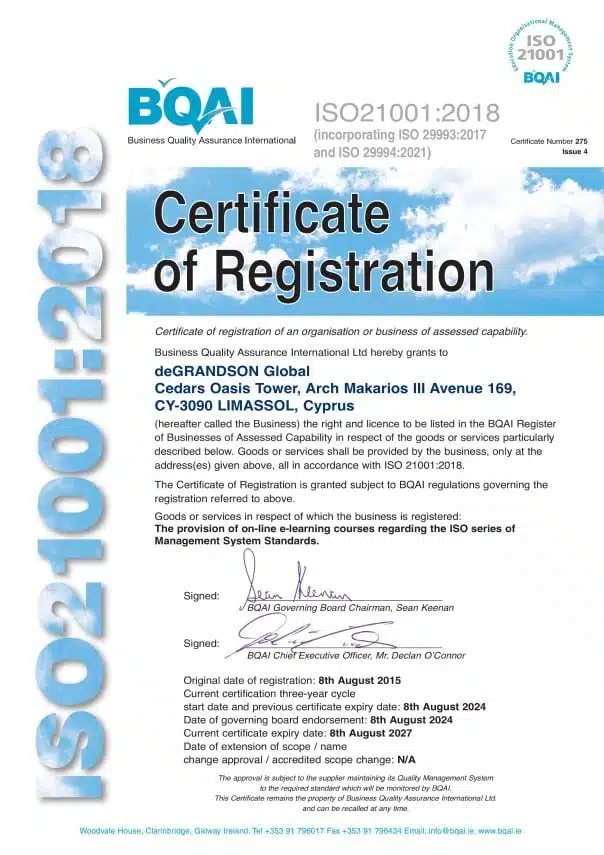
Yes. All deGRANDSON courses are certified to the following international standards:
ISO 21001:2018 – Educational Organizations Management Systems – ThisEnsures the course is designed and managed according to globally recognized education management practices.
ISO 29993:2017 – Learning Services Outside Formal Education- This covers non-traditional learning environments such as professional development programs, corporate training, and online courses.
ISO 29994:2021 – Additional Requirements for Distance Learning – This sets extra criteria for online and remote learning, including learner engagement, accessibility, and effective assessment methods.
The ISO 21001 certification is issued by Business Quality Assurance International (BQAI), an accredited body under the Irish National Accreditation Board (INAB).
INAB is a signatory to both the European cooperation for Accreditation (EA) Multilateral Agreement and the International Accreditation Forum (IAF) Multilateral Arrangement, ensuring global recognition of the qualification.
What benefits do courses being certified to these standards provide?
Recognition by Employers and Certification Bodies: Being accredited to international standards gives your certificate credibility, making it a globally recognized auditor qualification that enhances professional standing.
Consistency and Trust: Every module is developed and delivered under an externally audited educational management system, ensuring reliable, high-quality learning outcomes.
Confidence in Online Learning: ISO 29993 and ISO 29994 alignment guarantees that distance learning is effective, transparent, and engaging, validating your competency in a professional context.
Are your courses IRCA certified?
No, deGRANDSON’s ISO 45001 Auditor courses are ISO 21001 certified, which provides a university-grade, independently audited standard for educational organizations. While IRCA (now CQI/IRCA) approval is well-known, it is largely UK-focused, limited in ongoing monitoring, and does not audit the full educational organization.
ISO 21001, in contrast, ensures that both the learning services and the management of the provider meet international standards, giving learners and sponsoring organizations confidence in the effectiveness, reliability, and credibility of the training experience.
IRCA Approval vs ISO 21001 Certification Side-by-Side Comparison
Criteria
IRCA Approval
ISO 21001 Certification
Courses Approved
Yes
Yes
Approved Training Providers / Educational Organization (EO)
Yes
Yes
Published ATP / EO approval criteria
No
Yes
Internationally recognized ATP / EO approval criteria
No
Yes
Initial auditing of providers
Yes
Yes
Annual auditing of providers
No
Yes
Independent 3rd-party auditing
No
Yes
Low ongoing cost for ATP / EO
No
Yes
Recognized internationally
No
Yes
Free register of auditors
No
Yes
No ongoing cost for auditor registration
No
Yes
Curriculum approval & monitoring
No
Yes
Trainer / instructor approval & monitoring
No
Yes
Learning environment approval & monitoring
No
Yes
Monitoring delivery of learning services
No
Yes
Ongoing evaluation of learning goals and scope
No
Yes
Ongoing evaluation of the learning service
No
Yes
Ongoing evaluation of the learner experience
No
Yes
ISO certification
No
Yes
How do you enroll in an ISO 45001 Training Course?
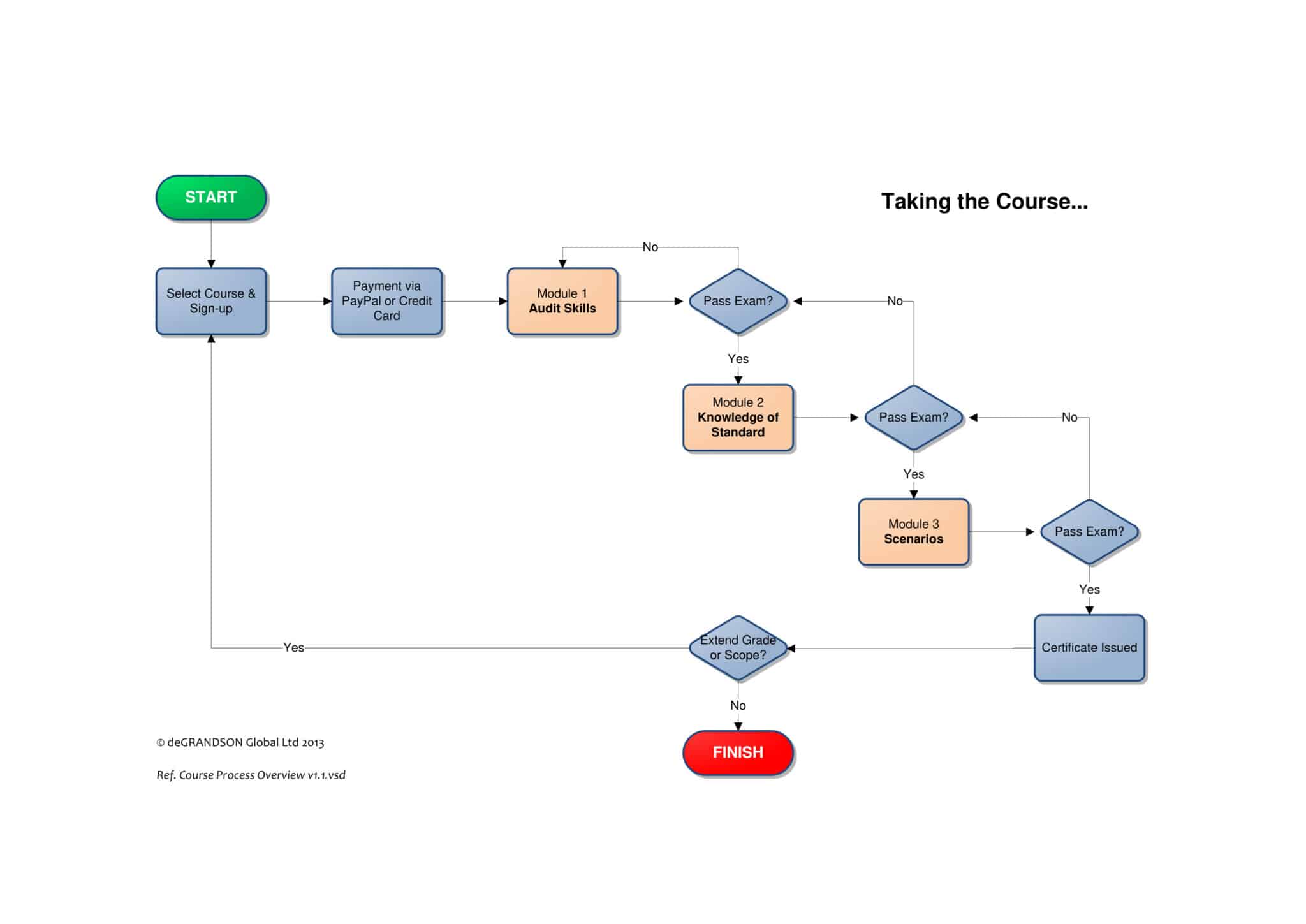
Enrollment in an online ISO 45001 course with deGRANDSON Global follows a straightforward, fully online process:
Choose your preferred Course;
Evaluate your skills to ensure the course level is appropriate;
Use the Add-to-Cart button to initiate the payment process;
Complete the process by enrolling the intended Learner(s).
Once enrollment is completed, you will receive email instructions (please check spam or junk folders). Follow the instructions to access the learning platform.
Our Courses are available on-demand and are self-paced so you can start the course whenever you wish – even today.
You can learn more about the process as well as answers to frequently asked questions about it on this Enrollment page.
What kinds of ISO 45001 courses are available?
deGRANDSON offers a wide variety of ISO 45001 training and certification courses including the following:
How are deGRANDSON’s ISO auditor, implementer, and consultant courses different from other courses?
When comparing different ISO auditor, implementer, or consultant courses, it can help to look beyond the course title alone and consider how the training is actually delivered, supported, assessed, and verified.
Small differences in structure, flexibility, resources, and certification processes can have a real impact on your learning experience and how useful the qualification is in practice.
The table below can help you compare these aspects side by side and decide whose courses best fits your needs and expectations.
Key Feature
deGRANDSON's ISO Auditor Courses
Usual ISO Auditor Courses
Certification Standard
Provider is certified to ISO 21001, meaning the educational organization's overall education management system itself is subject to periodic independent audits, with built-in international recognition.
Provider's course syllabi are recognized by bodies such as IRCA or Exemplar Global, where recognition applies more to the course content rather than the provider’s overall education management system.
Awarded Certification
ISO 9001 Internal Auditor certification is immediately issued upon passing the certification exam
PayPal or Stripe via credit/debit cards. Installment option also available for certain courses.
Varies; may be limited to bank transfer or invoicing
How is the ISO 45001 Auditor course delivered?
Courses are delivered fully online via a browser-based Learning Management System (LMS), accessible on any device without installing software. Learning is on-demand and self-paced, with no fixed schedules, allowing you to start anytime and pause or resume lessons—even across different devices—using the full resume feature.
To ensure uninterrupted progress, 24/7 Tutor Support is available through a built-in Support Ticket system, typically with responses within a few hours. You can learn more about delivery, access, and support on the FAQ page for course delivery.
How does the certification exam go?
Exams are conducted at the end of each course module (typically three modules per course), with durations ranging from 20 to 90 minutes, depending on the standard and scope.
All exams are taken completely online and open-book, allowing learners to use the relevant ISO standard, notes, and reference materials.
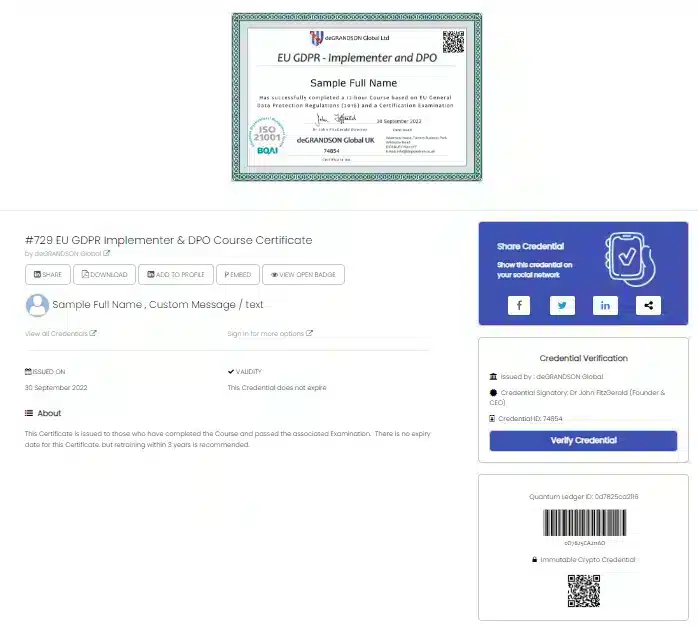
Responses are submitted on-screen using formats such as multiple-choice, matching, and true/false questions, designed to assess understanding and practical application rather than memorization. Once the certification exam is successfully completed, the learner will receive a link by email to their ISO Lead Auditor certificate, which will be available online and with instant access via a QR code.
Does taking your ISO 45001 training courses count toward Continued Professional Development?
Yes. ISO 45001 auditor, implementer, and consultant courses count toward Continuing Professional Development. CPD tracks formal and informal learning, including training, workshops, self-directed study, and practical application.
deGRANDSON developed its own CPD model, following best international practices and deriving rules for assigning CPD Units (sometimes called SCU Units in North America), enabling auditors to document ongoing skill development and demonstrate professional credibility.
Course
CPD / CEU Units
ISO 45001 Internal Auditor Certification
2.33
ISO 45001 Lead Auditor Certification
5.0
ISO 45001 Lead Implementer Certification
4.0
ISO 45001 Internal Auditor Extension
1.33
ISO 45001 Internal Auditor Conversion
1.33
ISO 45001 Lead Auditor Extension
3.66
ISO 45001 Lead Auditor Conversion Course
3.66
ISO 45001 Consultant & Lead Auditor Diploma
6.0
ISO 45001 Transition Training
2.66
Do You Have a Sample Lesson?
Yes. If you are interested in online ISO auditor training but not ready to start yet, we got you covered. We have a 5 min Trial Lesson that you can take to give you a quick overview of how our online training for ISO courses works. This includes our e-training methods, our certification process, and the differences among our ISO courses.
It also contains tips on how to find out which course will be appropriate for your needs. If you have more time and you want to take a closer look at our online courses, you can also check out our more detailed 30 min Trial Lesson. It contains an actual lesson sample as well as a short sample test that you can try for yourself.
Subscribe for a 10% Discount
Why choose deGRANDSON?
Internationally-recognized Certificates
Our ISO 21001 Educational Organization status is shown on all Certificates we issue.
Shareable Credentials
Instantly verify your qualification to a potential client or employer with our ISO auditor certificates that come with QR codes.
Self-paced and On-demand
Speed through to review the topics you understand well but take your time, and repeat as you wish, sections that are new or challenging.
Adult-Oriented Learning
Lesson delivered using methods suited to adult learning, including lessons, FAQs, and quizzes.
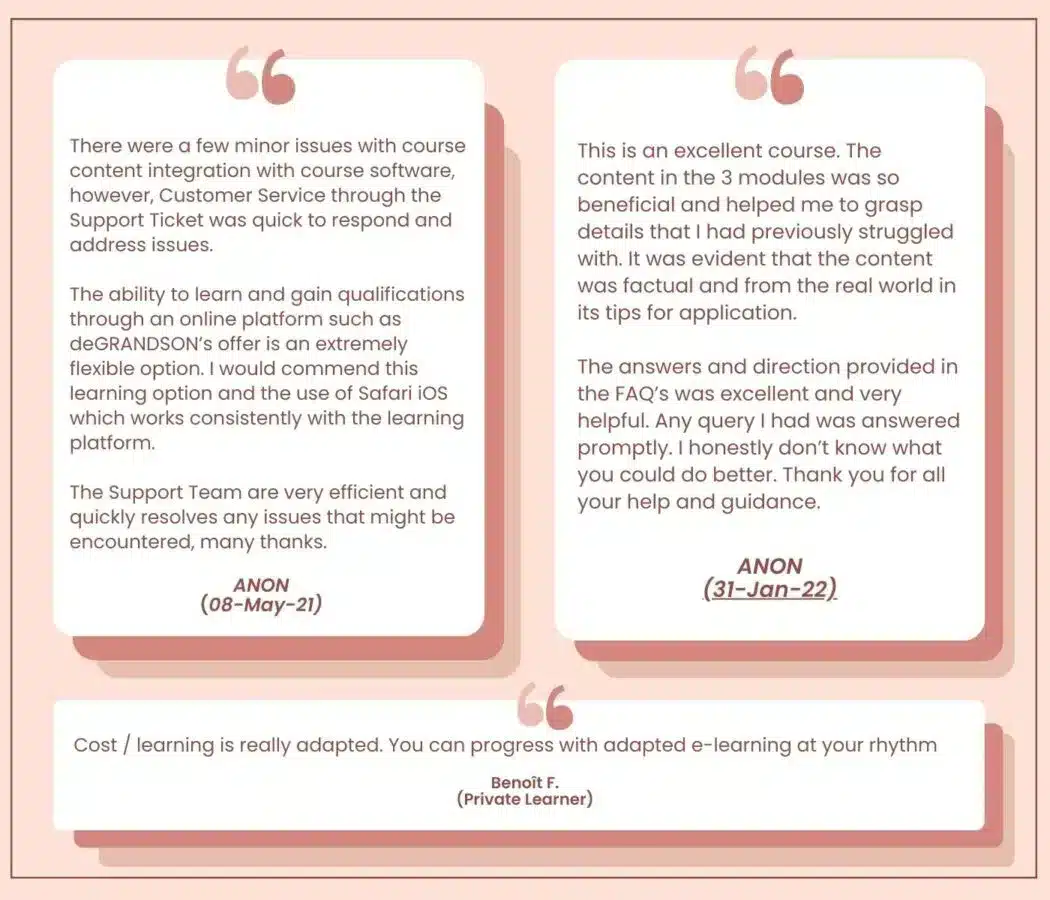
Satisfied Customers Say:
See what actual people who have taken our courses have to say:
Affordable ISO Auditor Training Cost
The total cost of deGRANDSON’s ISO Auditor training and certification courses are relatively affordable compared to typical ISO auditor training and certification cost.