


ISO 13485 Lead Auditor Refresher Content
If your knowledge of the Standard is not what it should be, this ISO 13485:2016 Lead Auditor Refresher training will quickly get your Certification up-to-date.
It will provide you with the Knowledge of the Standard, and the practical application of that knowledge with Audit Scenarios to enable you, as Audit Team Leader, to undertake and manage Certification Audits against the requirements of the ISO 13485 Standard.
Key Features:
- Course is accredited to ISO 21001, the standard for Educational Organizations Management Systems
- An ISO 13485 Lead Auditor certification is awarded upon passing the certification exam
- Certificate is immediately available online after the successful passing of the exam
- Certificate comes with a shareable QR code for instant verification of credentials
- Lessons range from 15 minutes to 1 hour, typically 20–30 minutes, ensuring that each topic is covered in suitable detail
- Course includes practice with scenarios that include dialogues
- Course includes 24/7 Live-chat Learner Support
- Course includes a learner manual, a copy of the standard, and samples of relevant forms and other documents
- Course comes with full-audio narration and Closed Captions for accessibility
- Courses are hosted on your browser so that no software has to be downloaded avoiding security risks.
- Course comes with quizzes, practice with scenarios, and open-book certification exam
- Course is hosted on your browser so that no software has to be downloaded avoiding security risks.
- Features cross-device compatibility (courses can be taken on any desktop, tablet, or mobile)
- Offers full-resume feature (end a session mid-lesson and continue exactly where you left off, even from a different device)
- Features real-time interactive content in a secure web-based environment
- Offers a clear learning path (once you've completed the internal auditor course, you have the option to progress to the lead auditor, up to the consultant and lead auditor course.
- Examination and certificate fee are already included in the course fee
- Payable via PayPal or Stripe using any credit or debit cards
- Option to pay in 4 monthly installments available
Who should take this Course?
This ISO 13485 Lead Auditor Refresher course is intended for:- Senior quality managers
- Quality professionals
- Regulatory professionals
- Compliance professionals
- Project managers
- Design engineers
- Software engineers
- Process owners
- Quality engineers
- Quality auditors
- Medical affairs
- Legal Professionals
What will I learn from the course?
This comprehensive ISO 13485 Lead Auditor Refresher Course is divided into three modules:- Module 0: Introduction and background to the Standard and to auditing.
- Module 1: Knowledge of the Standard, ISO 13485:2016, Medical Devices – Quality management systems – Requirements for regulatory purposes
- Introduction to ISO 13485:2016 - Overview of the ISO 13485 standard, its purpose, and significance in medical device quality management, covering regulatory compliance with MDR, IVDR, and FDA QSR/QMSR; industry applications across manufacturing, distribution, and supply chains.[deleted text].
- EU, UK, USA Regulations & MDSAP - EU, UK, USA Regulations & MDSAP - Discussion of regulatory frameworks for medical devices in the European Union, United Kingdom, and United States, including:
- EU Medical Device Regulation (MDR) 2017/745,
- In Vitro Diagnostic Regulation (IVDR) 2017/746,
- Harmonized Standards & ISO 13485, UK Medical Device Regulations 2002 (as amended),
- MHRA Oversight,
- Transitional Arrangements,
- Food and Drug Administration (FDA) Regulations including 21 CFR Part 820 – Quality System Regulation (QSR),
- 510(k) Premarket Notification,
- Premarket Approval (PMA),
- Unique Device Identification (UDI) System, and
- Medical Device Single Audit Program (MDSAP) covering regulatory requirements in: USA (FDA), Canada (Health Canada), EU (Notified Bodies, voluntary participation), Australia (Therapeutic Goods Administration - TGA), Brazil (ANVISA), Japan (PMDA & MHL).
- Developing & Implementing a QMS - Steps for establishing a Quality Management System (QMS) aligned with ISO 13485, including documentation of procedures, work instructions, and records; processes for design, manufacturing, and post-market activities; best practices for compliance, efficiency, and risk reduction; managing risks in product development and lifecycle; regulatory requirements for medical device approval and market access.
- Terms & Definitions – ISO 13485:2016 - Explanation of key terminology and definitions used in ISO 13485:2016, ensuring clarity in Quality Management System (QMS) implementation. Covers Quality Management System (QMS), Medical Device, Risk Management, Regulatory Requirements, Post-Market Surveillance (PMS), Corrective and Preventive Actions (CAPA), Nonconformity, Validation & Verification (V&V), and Unique Device Identification (UDI).
- Some Key aspects of QMS Auditing - Introduction to auditing principles, audit types, and key considerations for assessing compliance with ISO 13485, including first-party (internal), second-party (supplier), and third-party (certification) audits; audit planning, execution, and reporting; identifying nonconformities and corrective actions; evaluating process effectiveness and regulatory compliance; risk-based auditing approaches; auditor competencies and ethical considerations.
- Fundamentals of Medical Device Management Systems - Core concepts of managing medical devices within a QMS covering risk management in design, manufacturing, and post-market phases; product lifecycle from development to decommissioning; regulatory requirements for safety, performance, and market approval; document control for device specifications and compliance records; change management for design modifications; supplier management for component quality; and post-market surveillance for adverse event reporting and continuous improvement.
- Structure & content of ISO 13485:2016 - Breakdown of the standard’s clauses, detailing the requirements and expectations for compliance, including scope and applicability; normative references; terms and definitions; general QMS requirements; management responsibility and leadership; resource management; product realization processes; design and development controls; production and service provision; risk management integration; measurement, analysis, and improvement; and documentation and record-keeping obligations.
- Parts 1, 2 & 3 - Explanation of the first three sections of ISO 13485, covering general requirements for a QMS; documentation requirements, including quality manual, procedures, and records; risk-based approaches for decision-making, process controls, and regulatory compliance; and the standard’s alignment with global medical device regulations.
- Part 4: Quality Management System Requirements - Detailed discussion of the essential QMS requirements, including documentation of policies, procedures, and records; risk management integration into design, manufacturing, and post-market activities; operational controls for product realization and regulatory compliance; management of roles, responsibilities, and authorities; validation and verification of processes; and continual improvement through corrective and preventive actions.
- Part 5: Management Responsibility - Focuses on leadership commitment, policy development, planning, and review processes in a compliant Quality Management System (QMS), including establishing a quality policy and objectives; defining organizational roles, responsibilities, and authorities; conducting management reviews for performance evaluation and regulatory compliance; resource allocation for QMS effectiveness; risk-based decision-making in strategic planning; and ensuring regulatory and customer requirements are met.
- Part 6: Resources - Covers resource management, including personnel qualifications, training, and competency assessment; infrastructure requirements for facilities, equipment, and utilities; work environment controls to ensure product quality and safety; maintenance and calibration of equipment; supplier and external provider management; and allocation of resources for effective QMS implementation and continuous improvement.
- Part 7: Product Realization (3 lessons) - Examines the stages of product development, including design and development planning, inputs, outputs, verification, validation, and design changes; production and process controls to ensure product conformity; traceability requirements for identification and tracking; supplier management for procurement and quality assurance; control of monitoring and measuring equipment; and regulatory requirements for manufacturing and distribution.
- Part 8: Measurement, Analysis & Improvement (2 lessons) - Discusses performance evaluation, corrective actions, and continuous improvement methodologies, including monitoring and measuring QMS effectiveness; data analysis for identifying trends and risks; internal audits for compliance verification; corrective and preventive actions (CAPA) for addressing nonconformities; customer feedback and complaint handling; process validation and control; and ongoing improvements to enhance product quality and regulatory compliance.
- Annexes ZA & ZB (Amendment 11) - Analysis of key amendments related to the standard’s alignment with EU medical device regulations, including harmonization with the Medical Device Regulation (MDR) 2017/745 and In Vitro Diagnostic Regulation (IVDR) 2017/746; conformity assessment requirements; integration of risk management and post-market surveillance obligations; notified body expectations for certification; and regulatory transition provisions for compliance with updated EU directives.
- Advanced aspects of QMS Auditing (3 lessons) - In-depth exploration of audit techniques, risk-based auditing, and handling nonconformities, including advanced audit planning and execution strategies; risk-based auditing approaches for prioritizing high-impact areas; root cause analysis for identifying systemic issues; effective communication and interviewing techniques during audits; handling major and minor nonconformities; corrective action verification and follow-up audits; and best practices for ensuring continuous improvement and regulatory compliance.
- FAQs about the Standard
- Online Course Examination
- Module 2: Practice with Scenarios, based on actual audits and includes advice on dealing with awkward situations and individuals.
- Audit Scenarios – Internal Auditor
- More Audit Scenarios – Lead Implementers
- Yet more Audit Scenarios – Lead Auditors
- FAQs about the Auditing Experience
- Online Final Examination
What Course Materials are included?
The ISO 13485 Lead Auditor Refresher Course comes with:- Diagram: ISO Auditor Certification Process
- Diagram: 6-Stage Audit Process
- Sample Code of Ethics
- Management of an Audit Programme
- Sample Audit Plan
- Sample Audit Work Order
- Sample Nonconformity Report
- Sample Working Document & Checklist
- Risk Assessment Tools and Methodologies
- Documented Information Requirements of ISO 13485:2016
- Determining the Context of the Organization
- ISO 13485:2016 and Risk Management
- Risk Assessment Tools and Methodologies (with examples)
- Terms & Definitions
- Typical Process Map
How is the Course delivered?
The ISO 13485 Lead Auditor Refresher Course is delivered online from our Learning Management System (LMS) at www.degrandsonLMS.com (provided by Inquisiq). All Modules have a full resume and scaling capabilities. This means, for example, you can:- Start a Module at work on your Work Station running on Windows 11,
- Continue the Module on the train home on your iPad running on iOS 13 and,
- Complete the Module at home on your Notebook PC running on Windows 10.
What Qualifications do I need?
If you have previously completed a Lead Auditor Course with deGRANDSON Global, you are pre-qualified. Just log-in, enrol and start your program immediately. If you have NOT previously completed an Internal Auditor Program with deGRANDSON Global, you are advised to complete a free Pre-Test first in order to demonstrate adequate auditing skills.The Pre-Test will take 30 minutes approx. and is FREE. Click this link to begin: Check your Lead Auditor Skills.
Regarding prerequisite qualifications generally for Lead Auditor Programs, the minimum of a Secondary School Certificate (such as a High School Diploma, Baccalaureate or similar National Vocational Qualification) combined with 5 years’ work experience, with 2 at managerial/supervisory level, is recommended.
You do not have to provide us with any evidence of your qualifications and experience. However, if you do not meet these requirements, you can expect to struggle with this program.
Related Courses





Course Author

Dr John FitzGerald graduated with a 1st class honours degree in chemistry and a PhD in synthetic organic chemistry. He worked for 15 years in the manufacturing industry, then as a trainer and consultant in the UK and Ireland before founding deGRANDSON Global in 2009.
He serves as the company Director and course developer while occasionally working as a Lead Auditor on ISO 9001, ISO 13485, ISO 14001, ISO 27001, ISO 45001, and ISO 55001 audits for an accredited certification body (CAB).




Our Certification

deGRANDSON Global has three university-grade management system certification including ISO 21001, Educational Organizational Management System; ISO 29993, Learning Services outside formal Education; and ISO 29994, Learning Services – additional requirements for Distance Learning.
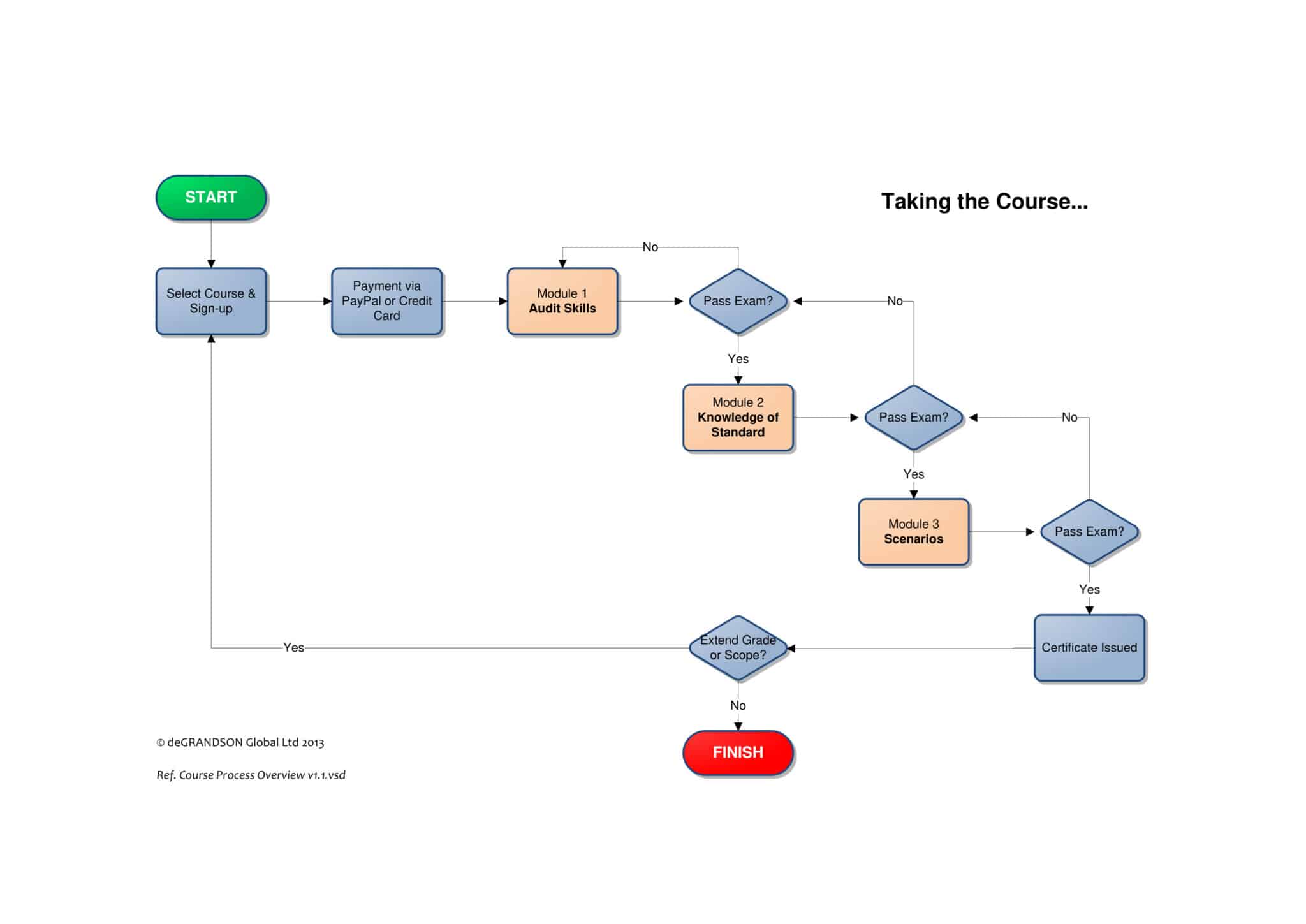
Enrollment, Training, and Certification Process
Group Discount

Get 10, 15, and 25% discount when you enroll 3, 10, 20 or more people.
Free Gap Analysis Tool
Identify systems or process gaps in your management system that can be improved with our ISO 13485 Gap Analysis tool.
Sample Learner Certificate
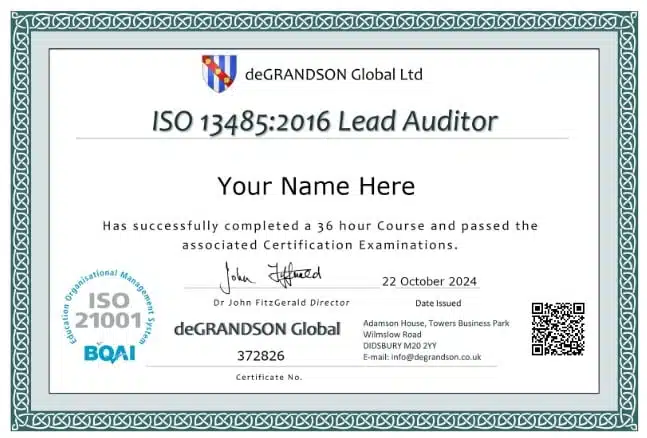
deGRANDSON Global certificates issued to learners who successfully completed the training and passed the certification exam come with QR codes that can be shared on online profiles to instantly verify qualification to prospective clients or employers.