What are ISO Auditor Conversion Courses?
ISO Auditor Conversion courses are designed to help auditors update their qualifications when an ISO standard changes. Instead of repeating full auditor training, ISO auditor conversion courses focus on what’s new, what’s been removed, and how to apply your existing skills to the revised standard.
By taking a conversion course, you ensure you continue to meet the competency requirements for auditors and maintain your credibility. It’s also a valuable part of continuing education for auditors, helping you stay relevant and competitive in your career.
Why take an ISO Auditor Conversion Course?
Many revised and new ISO Management System Standards were published from 2015 through 2020. Conversion courses give experienced auditors a practical way to upgrade their certification without starting over from scratch.
For organizations, conversion courses mean an easier move to the new standard and shorter work downtime. For auditors, conversion courses mean a straightforward way of maintaining auditor credentials and staying on track with the certification renewal process.
What are examples of ISO Auditor Conversion Courses?
deGRANDSON offers a range of ISO conversion courses to help professionals stay up to date with the latest revisions of international standards. Each course highlights the key updates, structural changes, and new requirements introduced in the most recent versions—ensuring auditors maintain their competence and compliance.
Here are some examples:
- OHSAS 18001 to ISO 45001:2018: Auditors previously trained on OHSAS 18001 can update their skills and certification to ISO 45001, focusing on the new structure, risk-based approach, and leadership requirements.
- ISO/IEC 17025:2005 to ISO/IEC 17025:2017: Auditors experienced with the 2005 version learn to apply updated process requirements, risk-based thinking, and laboratory management system enhancements.
- ISO 27001:2013 to ISO 27001:2022: Conversion Courses cover the updated information security controls, revised Annex A, and enhanced risk treatment requirements.
Scope
Do your ISO Auditor conversion courses provide comparisons of the old versus new processes to highlight key differences?
Yes. deGRANDSON’s ISO Auditor Conversion Courses are designed to give you a clear understanding of what has changed from the previous version of the standard, and how those changes affect the way audits are planned and carried out.
Is there specific training on conducting integrated audits using both the old and new versions of standards?
Old and new standards are never audited together. After implementing the necessary changes, you stop auditing the old version and switch to auditing the new one.
Do your ISO Auditor Conversion courses include new risk management approaches introduced in the updated standard?
It varies from one standard to another. In general, a risk-based approach is required for all Standards, while some standards have additional requirements for formal risk management of specified requirements.
No. This is beyond the scope of our Courses.
Can the course teach how to conduct combined audits of organizations implementing both old and new versions of the ISO standards?
No. Courses are focused on a stated version of the Standard.
Do your ISO Auditor Conversion courses cover how to audit the cross-functional elements affected by the new requirements?
Yes. A Module devoted to Scenarios is included in our Courses where we explore such issues.
Do the courses cover how to handle audits of external organizations that may still be working under the older version of the standard?
No. Courses only cover the one stated version of a Standard.
Do the courses cover adapting the audit approach based on the specific changes in the new ISO standard?
Yes. Our ISO Auditor Conversion courses will guide you in adapting your audit approach to the updated requirements, highlighting clause changes and practical implications.
You’ll learn to prioritize new or revised areas, evaluate evidence effectively, and plan audits efficiently. A Gap Analysis tool is included to help identify the differences between the old and new versions, ensuring you can bridge the move in your own audits.
Is there guidance on how to approach transitioning from the previous standard during an audit?
Simply begin auditing against the requirements of the revised standard.
Are there best practices provided for implementing the new standard efficiently and effectively within an organization?
If your goal is to learn best practices for implementing the new ISO standard efficiently and effectively within your organization, then our Lead Implementer Courses are the best fit for you.
These courses focus on the practical application and integration of updated ISO requirements into real-world operations.
Course Content
What specific topics are covered in the ISO auditor conversion courses? Is there a detailed focus on the areas of the standard that have changed?
The course content of our ISO auditor conversion courses can vary per standard, but they cover all significant topics, with particular emphasis on the standard’s areas that have undergone changes, additions, or deletions.
Typical areas of focus include:
- Clause-by-clause comparison — side-by-side reviews between the old and new standard so you know exactly what changed.
- New or reworked requirements — for example, updated risk approaches, leadership responsibilities, and changes tied to ISO Annex structure alignment.
- Practical auditing guidance — how to sample, evaluate evidence, and write findings against the new requirements (often using scenarios based on real audits).
- Switching over to the new standard — including certification body expectations, possible deadlines, and how to maintain certification during the switch.
How does the updated standard influence the organization’s risk management and audit focus areas?
It depends on the individual Standards requirements.
Are there flexible audit methodologies provided to account for varying degrees of implementation within an organization?
No. ISO 19001 sets the standard for performing all ISO management system audits.
Are there specific updates to internal audit records, audit checklists, or other documentation required by the new standard?
No. This detail is left to the organization implementing the management system in question.
Course Materials
Our ISO Auditor Conversion courses provide training resources to help you understand and apply the updated requirements of each standard. These include practical tools, examples, and guidance that act as both learning aids and ISO compliance tools for your ongoing audit work. For example:
- ISO 45001: Hazard Identification Checklist and Sample Nonconformity Report, with an emphasis on updated risk-based approaches and leadership responsibilities.
- ISO 17025: Sample Audit Plan and Terms & Definitions focus on updated process requirements, including risk-based thinking for testing and calibration laboratories under ISO 17025:2017.
- ISO 17025 Lead Auditor: Gap Analysis Tool and Risk Assessment Examples, showing new structural requirements and advanced auditing practices for laboratory management systems.
- ISO 27001: Auditor’s Workbook for Annex A, Sample Statement of Applicability, and Information Security Risk Management Process, supported by sample audit reports that illustrate updated information security controls.
Will the courses provide ongoing resources, such as updated auditing tools, templates, or access to expert networks, after completion?
Comprehensive Course Materials are provided. As the standard and its requirements will not change, no additional materials will be needed.
Are there tools to help streamline the audit process, especially for organizations undergoing the transition?
Tools? No. But we offer free Tutor Support during and for six months after Courses are completed.
Does the course offer resources or guidance for training internal auditors within organizations on the changes to the updated ISO standard?
No. We recommend formal training for all internal auditors and offer a wide range of online courses.
Course Delivery
Are the ISO Auditor Conversion courses fully online and self-paced, or are there fixed schedules I need to follow?
They are fully online, browser-based, and self-paced — no downloads or special software required. You can study on any desktop, tablet, or mobile device, at the time that best suits you.
Course Requirements
Are there any specific prerequisites for taking the conversion course? For example, do I need to have completed certain audits under the old version before transitioning?
Certification to the previous version/edition of the Standard is the only requirement.
Will my existing certification need to be verified or updated before enrolling?
No. We accept the Learner’s word. Of course, if the Learner is not adequately qualified, they will likely struggle with the Course.
Regulatory Compliance
Are there any legal or regulatory changes tied to the updated ISO standard that I should be aware of?
All ISO management system standards require that applicable legal and regulatory requirements be met, which will, of course, change from one jurisdiction to another.
How do the updated standards align with industry regulations or government compliance requirements?
As applicable legal and regulatory requirements change, the management systems must also change to accommodate them.
What is the typical duration within which an organization must transition to the updated standard?
It usually takes 2 to 4 months, depending on the resources committed to filling the ‘gaps’ and implementing the necessary changes.
Inadequate internal auditing to identify nonconformities, especially in relation to new or changed requirements, prior to a certification body audit is a common failure.
Does the updated standard introduce new legal or contractual obligations that organizations must be aware of?
No, there are no new legal requirements. However, new contractual requirements, such as written quality agreements, do arise from time to time.
How does the course address any legal ramifications of noncompliance with the updated standard?
ISO Management System Standards do not address this issue.
Certification
How do I Upgrade My Auditor Certification?
Are you already an Auditor? If so, you don’t have to complete conventional auditor training courses. Instead, you can upgrade your auditor certification for new and revised standards.
Generally, auditors’ only choices were to take complete conventional auditor training courses. However, this comes with certain costs and time commitments.
Furthermore, the content may only cater to some of your specific needs. In some cases, you may have to engage the services of a consultant. This can also be quite costly.
Our online Lead Auditor training and Internal Auditor conversion courses can provide a better alternative.
Not only does it involve moderate cost, but it can also help you save time.
NOTE: We also have Transition Courses and Refresher Courses to aid in migrating your QMS, EMS, etc., to the revised Standards.
What if the Conversion Course I Want is Not Available?
Our offering grows as new Standards are published. Check out the menu at the top of the page to see what’s currently available.
Do your ISO Auditor Conversion courses provide any additional certification options or pathways for auditors who want to expand their expertise beyond the updated standard?
If you’re interested in expanding your auditing qualifications beyond the updated version of your current ISO standard, deGRANDSON offers Extension Courses to help you do just that.
These programs are ideal for professionals who have already completed ISO auditor training and want to gain certification in a different management system standard, for example, adding ISO 9001 internal auditor certification to your existing ISO 45001 internal auditor certification.
Will these updated auditor certifications be recognized globally and by the appropriate accreditation bodies?
Yes. The certifications you earn through deGRANDSON’s ISO Auditor Conversion Courses are internationally recognized because they are issued under ISO 21001, the standard for educational organizations, which guarantees their acceptance worldwide.
How long will my current certification for the previous version remain valid, and how will it affect my audit practices during the transition?
A transition period of three years from the publication of a new version of a Standard is the norm.
Absolutely. The HLS – High-Level Structure common to ISO Standards helps greatly here.
Are there changes to how certification bodies handle assessments under the new standard?
No. All audits must be performed in compliance with ISO 19011.
Does the course provide insight into how certification bodies themselves are adjusting to the updated ISO requirements?
Yes. Courses include many tips and commentary on how Certification Body Auditors will interpret a Standard.
Do your ISO Auditor certificates need to be renewed?
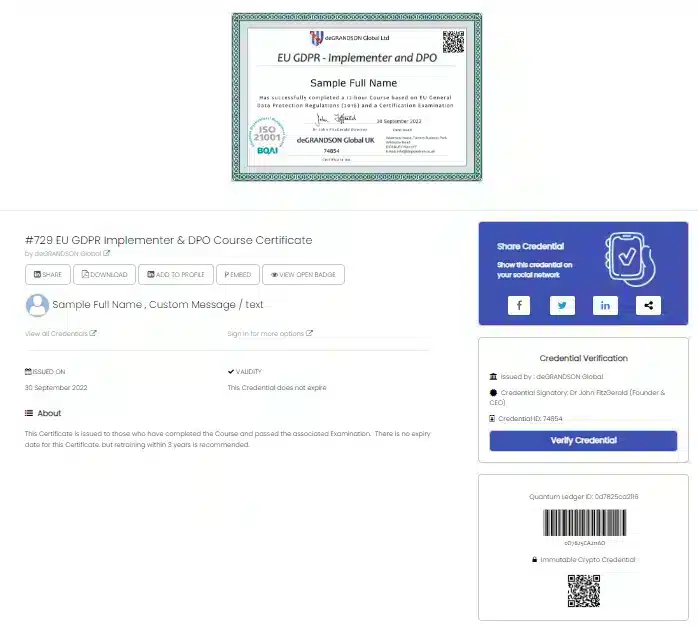
No. ISO Auditor certificates issued by deGRANDSON do not have expiry dates. Unlike some professional qualifications that require frequent renewal, you only need to complete a Conversion Course when a new or revised edition of a standard is published—typically every 5 to 10 years. This means you can maintain your credentials with minimal disruption.
How do these certifications compare with other professional development options?
Each of our ISO Auditor Conversion courses carry a set number of Continuing Professional Development (CPD) units, which are displayed on the Course Pages.
These units give you a way to measure the value of your training and compare it against other learning opportunities you may be considering.
Compared to alternatives such as short workshops, in-house training, or generic professional development seminars, these courses stand out because they:
- Directly expand your auditing credentials – extending your scope to new ISO standards rather than just adding general knowledge.
- Provide structured CPD units – making it easy to track and report your professional learning.
- Combine recognition with application – you don’t just learn concepts, you also gain a credential that demonstrates competence to employers and clients.
- Offer long-term value – unlike one-off seminars, these certifications stay relevant as part of your auditing career path.
Do deGRANDSON’s ISO auditor conversion courses have IRCA or Exemplar Approval?
deGRANDSON courses are certified to ISO 21001 rather than IRCA or Exemplar. This is because ISO 21001 provides strict, independently audited assurance of both the learning services and the management of the educational organization.
Unlike IRCA or Exemplar approvals, which function mainly as badges with limited international recognition and minimal ongoing monitoring, ISO 21001 requires continual evaluation of curricula, learning outcomes, and organizational processes.
Career Prospects
How soon after taking the course can I start auditing to the new standard?
Immediately.
Are there industry-specific elements or sectors where the new version of the ISO standard is especially critical?
Any such requirements will be detailed in the revised standard itself.
Are there opportunities for further specialization or advanced learning after completing the conversion course?
No, the conversion courses are intended to be complete in themselves.
Will this course help me audit organizations that are certified to multiple standards, especially if they’ve updated one but not others (e.g., auditing both ISO 9001:2015 and ISO 45001:2018)?
While auditing skills can be applied to any ISO management system standard, the auditor must know each standard to be audited. Extension Courses are for adding knowledge of additional Standards.
How can organizations leverage the updates to the ISO standard to drive continuous improvement and business performance?
The ISO publishes various guides and explanatory standards.
What long-term benefits will organizations and auditors gain by transitioning to the updated ISO standard?
The primary benefit is maintaining certification to the Standard in question.
Completing an ISO 21001-certified course signals to employers, clients, and project sponsors worldwide that the auditor has received training from a fully accountable, high-standard organization—enhancing credibility, employability, and the ability to secure project contracts.