What Does QHSE Mean and Why Does It Matter?
QHSE represents four interconnected management disciplines: Quality, Health, Safety, and Environment. Each discipline has its own ISO standard. ISO 9001 covers quality management. ISO 45001 addresses occupational health and safety, while ISO 14001 addresses environmental management.
Organizations often implement these standards together because they share a common structure (the Annex SL framework). This means a single integrated management system can address quality, worker safety, and environmental performance simultaneously. For you as a professional, QHSE training opens doors across all three disciplines.
How is QHSE different from HSEQ and SHEQ?
QHSE, HSEQ, and SHEQ are commonly used terms, but they have no official standing. They are equivalent and are most often used as part of a job title.
Their use does not indicate that the holder of the position is a certified auditor for ISO 9001, ISO 14001, and ISO 45001 and they neither claim nor infer a formal qualification
What does IMS mean?
The term IMS stands for Integrated Management System. This term evolved in the Anglosphere about 20 years ago. Generally, it applies to ISO Auditors who are trained in ISO 9001, ISO 14001, and ISO 45001, i.e., all three standards. Combined Courses are typically offered at Lead Auditor and Internal Auditor. For example, see our Courses for IMS Lead Auditor and IMS Internal Auditor.
An IMS, however, is not confined to the traditional combination of standards. For example, an office-based business may get little value from certification to the environmental standard, ISO 14001. In such situations, an IMS based on ISO 9001, ISO 27001 (information security), and ISO 45001 may be a superior option. Even more, you are not limited to three standards for your IMS.
We know of an American multinational company in Galway, Ireland, that successfully maintains an IMS with six standards. The makeup of your IMS should match your business needs and, of course, add value.
What is the Relationship Between QHSE and Integrated Management Systems?
An Integrated Management System (IMS) combines two or more management systems into one cohesive framework. Many organizations merge their ISO 9001, ISO 14001, and ISO 45001 systems to reduce duplication, cut audit costs, and streamline documentation.
If you work in a company with an IMS, you’ll benefit from training that covers multiple standards. Some professionals start with one standard and add competencies in others over time. Others pursue integrated auditor qualifications from the outset.
Are Integrated Management Systems Easy to Implement or Maintain?
Having an IMS is not an easy option. While certain processes and procedures will be common to all standards (e.g., internal auditing or document control), your certification body will audit your system against each standard individually; i.e., all requirements of the individual standards will be audited.
Therefore, for example, a traditional IMS will need to address business risks and opportunities separately from environmental aspects and impacts, and separately from OH&S hazards and controls. Your IMS, therefore, will need to be carefully and comprehensively assembled.
What if you’re already a certified auditor to ISO 9001 or another standard?
You do not need to take an IMS Course or courses in the individual ‘missing’ standards. Instead of taking a Lead Auditor Course (typically, 36 hours), you can take a Lead Auditor Extension Course (typically, 24 hours) and save both time and money. These Courses are not easy to find, but we at deGRANDSON offer a wide range of ISO training course options.
What if you want to become a QHSE Consultant?
The challenge here is that, as with Lead Auditor Courses, auditing skills alone are not sufficient; you also need the knowledge and skills to implement and maintain an IMS. The answer is the QHSE Consultant Diploma Course. This course includes 3 sets of Implementation Handbooks (each 100+ pages), Sample Documentation, and Record Templates. Check it out – typically, 60 hours to complete and secure a Diploma Certificate with ISO 21001 accreditation.
What is the difference between the QHSE Course Types and the QHSE Consultant Course?
The main difference between the QHSE Course Types and the QHSE Consultant Course is structure and scope.
While many professionals choose to build their QHSE competencies progressively by completing separate ISO 9001, ISO 14001, and ISO 45001 Internal Auditor, Lead Auditor, and Lead Implementer courses over time, the fastest and often most cost-effective route to QHSE Consultant level is the QHSE Consultant Diploma Course.
Rather than enrolling in multiple individual programs across the quality, environmental, and occupational health & safety disciplines, this course combines the key knowledge, implementation guidance, and practical resources from these pathways into a single package, providing a structured route toward developing the broader skills expected of a QHSE consultant.
When should you choose individual QHSE course types and when should you choose the QHSE Consultant Course?
If your goal is to develop expertise in a specific discipline, you can take the individual ISO 9001, ISO 14001, and ISO 45001 courses separately. This approach allows you to focus on one area at a time and progressively build your knowledge through Internal Auditor, Lead Auditor, and Lead Implementer qualifications. Many professionals choose this route because it offers flexibility and enables training to be spread over a longer period.
The QHSE Consultant Diploma Course takes a different approach. Instead of studying quality, health & safety, and environmental management through separate learning paths, it combines the key concepts, implementation knowledge, and practical resources from all three disciplines into a single programme.


What kinds of QHSE Courses can I Choose From?
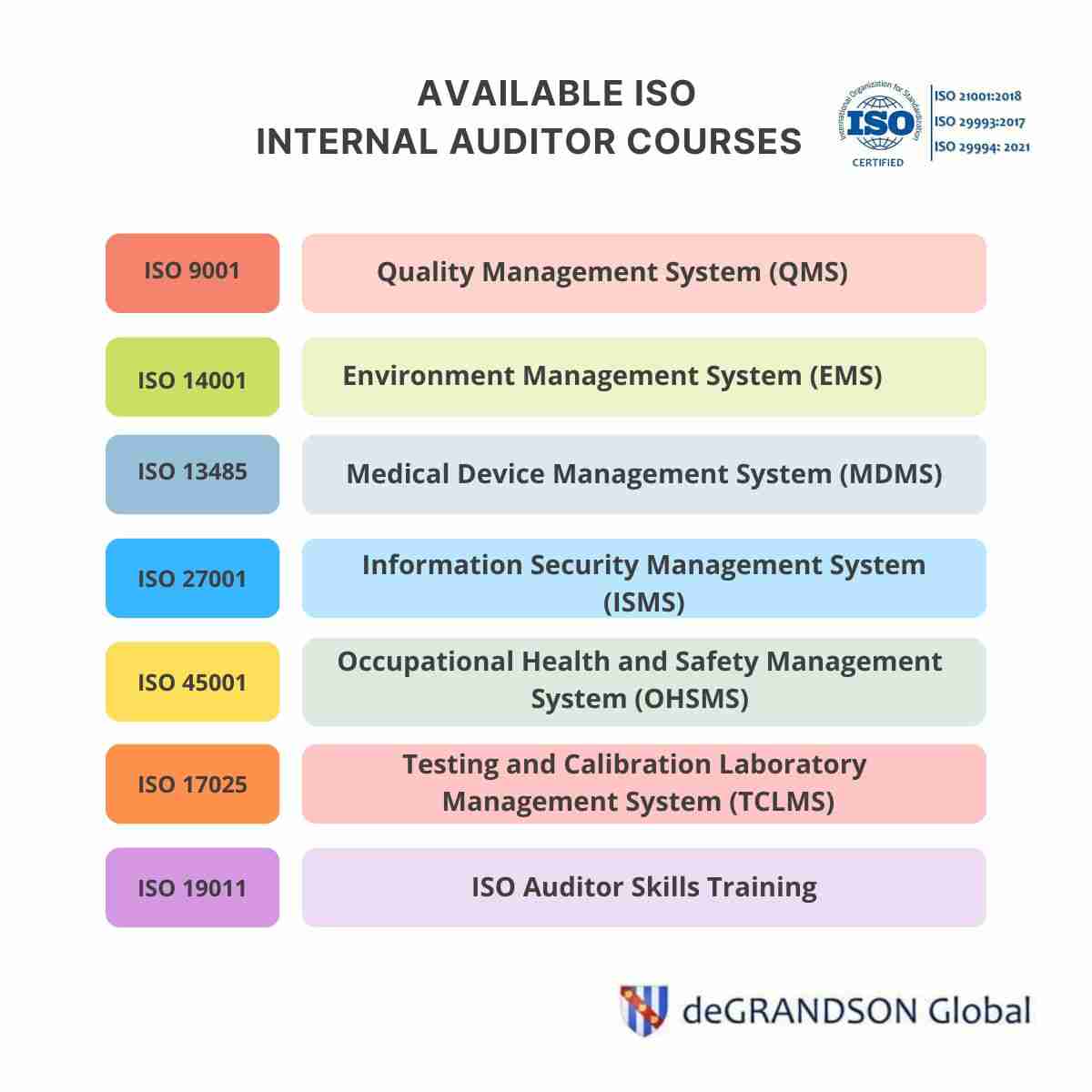
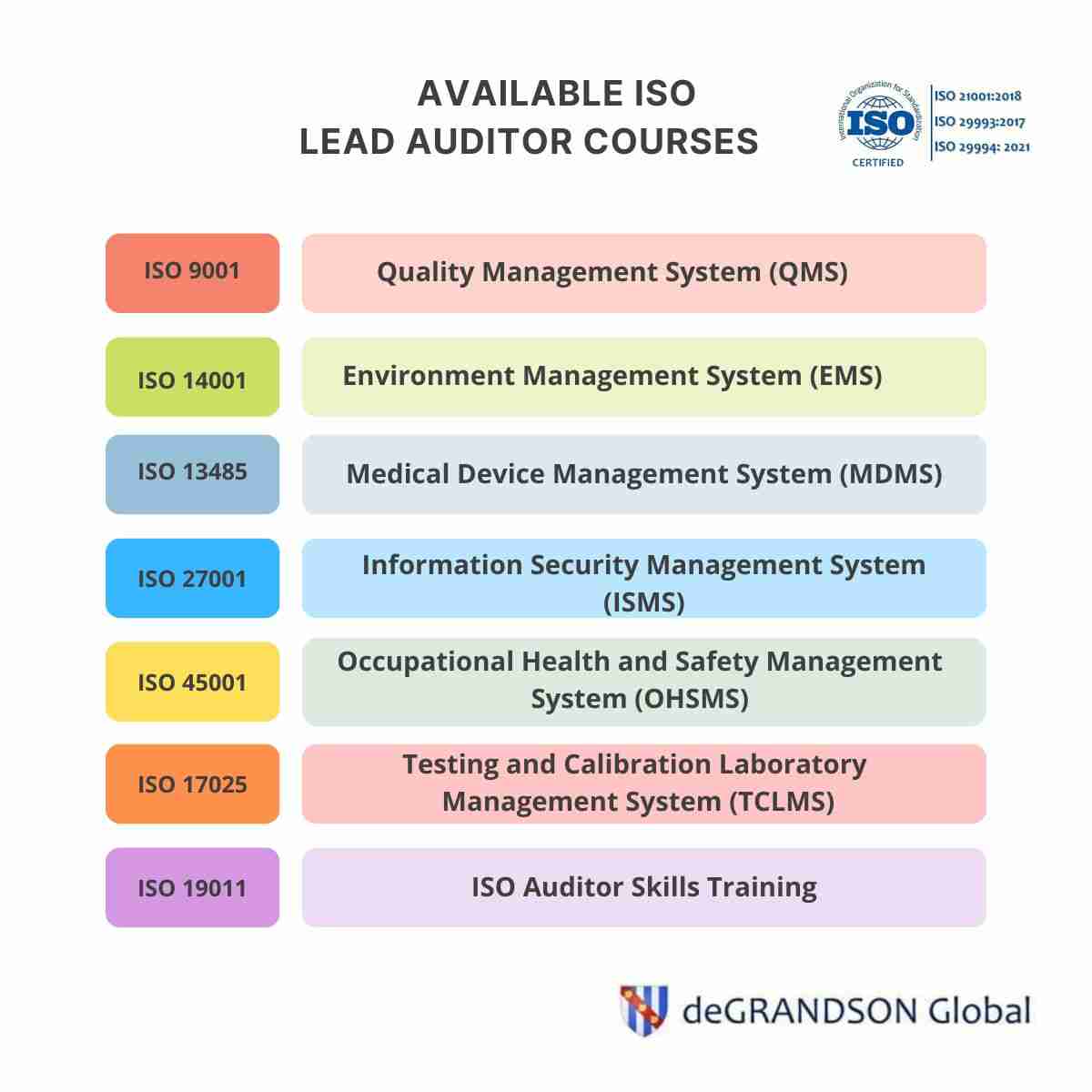
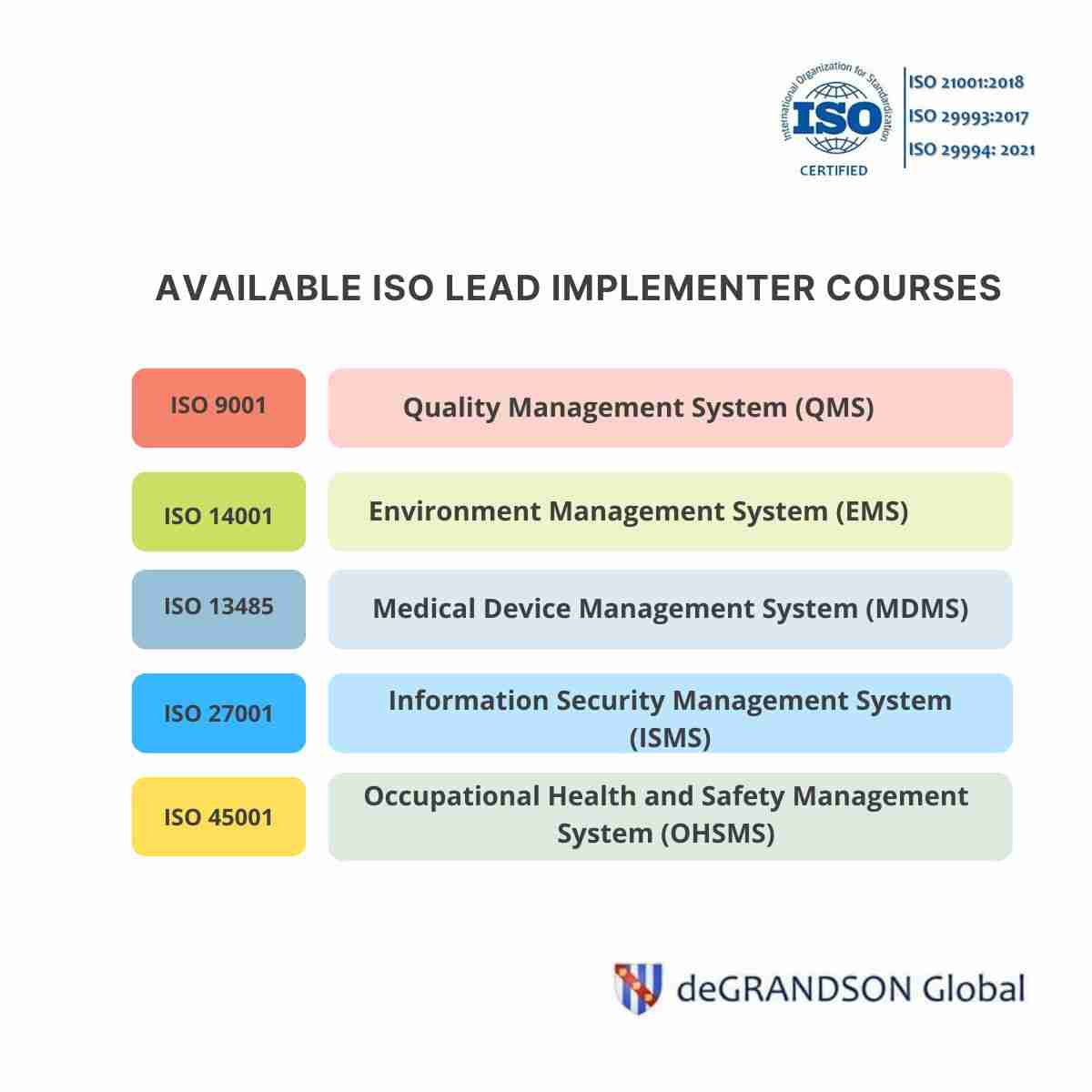
Four primary certification pathways exist for QHSE professionals: Internal Auditor, Lead Auditor, Lead Implementer, and QHSE Consultant courses. Each serves a distinct purpose in the ISO management system lifecycle. Your career objectives determine which path fits you.
| Course Type | Purpose | Key Content | Typical Study Time / Requirements |
|---|---|---|---|
| Internal Auditor Courses | Internal Auditor training prepares you to conduct first-party audits on behalf of your own organization. You’ll learn to assess whether your company’s management system conforms to ISO requirements and whether processes work as intended. | Internal auditor courses cover the relevant standards’ requirements, audit principles based on ISO 19011, and techniques for gathering objective evidence. | Typically the entry point for QHSE professionals. Course duration is usually around 16–20 hours of study time. |
| Lead Auditor Courses | Lead Auditor certification enables you to plan, lead, and report on second-party (supplier) and third-party (certification body) audits. This qualification is essential if you want to work as an external auditor or conduct supplier assessments. | Covers audit program management, team leadership, audit planning and execution, nonconformity writing, and closing meetings. | More extensive than internal auditor programs. Expect around 40 hours of study time.
Prior knowledge of the standard and some audit experience is recommended. |
| Lead Implementer Courses | Lead Implementer training teaches you how to establish, implement, and maintain an ISO management system from scratch. This pathway suits system design roles rather than auditing. | Covers gap analysis, documentation development, risk assessment methodologies, and preparing for certification audits. | Suitable for QHSE managers, quality managers, and consultants involved in system implementation and certification preparation. Usually takes between 35–45 hours of study time. |
| QHSE Consultant Diploma Course (ISO 9001 + ISO 14001 + ISO 45001) | This course is designed to develop integrated QHSE consultancy-level capability by combining quality, environmental, and occupational health & safety management system knowledge into a single structured program.
It prepares learners to understand, implement, audit, and support integrated management systems across all three ISO standards. |
Covers auditing principles based on ISO 19011, core requirements and application of ISO 9001:2015, ISO 14001:2015, and ISO 45001:2018, and how these standards integrate within a unified QHSE management system.
Includes practical implementation guidance through detailed handbooks and scenario-based learning to build real-world consulting and system support capability. |
Approximately 60 hours of study time (including auditor certification exam).
Combines structured learning across all three ISO disciplines with integrated implementation and auditing knowledge suitable for consultancy-level roles. |

How to Match Your Job Role to the Right QHSE Course Path
Your current position and career aspirations should drive your course selection. Different roles demand different competencies. Here’s how to align your training with your professional goals.
| Role Type | Course Recommendations | Purpose / Focus | Requirements / Progression |
|---|---|---|---|
| QHSE Manager and Quality Manager | Start with Internal Auditor certification in your primary standard (often ISO 9001 for quality managers or ISO 45001 for HSE managers).
Add Lead Implementer training if responsible for building or maintaining the management system. |
Broad competence across auditing and implementation for managing organizational QHSE functions. | Many QHSE managers progress to Lead Auditor certification to deepen audit skills and enhance professional credibility. |
| QHSE Consultant | Lead Implementer training to guide clients through system development.
Lead Auditor certification to strengthen credibility and support certification preparation. |
Full toolkit for supporting multiple organizations through ISO certification processes. | deGRANDSON Global offers a QHSE Consultant Professional Diploma combining ISO 9001, ISO 14001, and ISO 45001 training for integrated competence. |
| Certification Body Auditor | Lead Auditor certification is mandatory for working with accredited certification bodies conducting third-party audits. | Qualification required for external auditing roles within certification bodies. | Requires documented audit experience and completed Lead Auditor training. Ongoing competence maintenance is expected through refresher training courses. |

What are the Course Options for Quality Professionals?
ISO 9001 is the most widely adopted management system standard globally. It establishes requirements for a quality management system (QMS) focused on customer satisfaction and process improvement. Quality professionals at all levels benefit from ISO 9001 training.
| Course Focus | Key Skills Covered | Suitable For | |
|---|---|---|---|
| ISO 9001 Internal Auditor | The ISO 9001 Internal Auditor course teaches you to audit quality management systems against the standard’s requirements. | Clause-by-clause interpretation, audit planning techniques, and writing meaningful audit findings. | deGRANDSON Global’s ISO 9001 Internal Auditor course covers the full standard along with practical exercises.
It’s suitable for quality engineers, quality coordinators, and anyone involved in maintaining the QMS. |
| ISO 9001 Lead Auditor | ISO 9001 Lead Auditor training builds on internal auditor knowledge, equipping you with advanced skills to manage audit teams and conduct certification audits. | Opening and closing meetings, coordinating the auditor team, and making certification recommendations. | deGRANDSON Global’s ISO 9001 Lead Auditor course equips you with advanced skills to manage audit teams and conduct certification audits.
It’s valuable for senior quality professionals, supplier quality engineers who assess vendor systems, and anyone pursuing a career in third-party auditing. |
| ISO 9001 Lead Implementer | The ISO 9001 Lead Implementer course focuses on building a QMS rather than auditing one. | Gap analysis, quality policy and objectives development, documented information creation, and certification preparation. | deGRANDSON Global’s ISO 9001 Lead Implementer course covers practical implementation steps from initial planning through successful certification.
It is suitable for Management representatives, quality directors, and consultants.
|
What are the Course Options for Environmental Professionals?
ISO 14001 specifies requirements for an environmental management system (EMS). It helps organizations identify, control, and reduce their environmental impact. Environmental managers, sustainability professionals, and QHSE generalists all benefit from ISO 14001 training.
| Certification Path | Course Focus | Key Knowledge and Skills Covered | Suitable For |
|---|---|---|---|
| ISO 14001 Internal Auditor | Auditing organizations’ environmental management systems. | ISO 14001 requirements, environmental terminology, and audit techniques specific to environmental management.Assessing environmental aspects, evaluating legal compliance processes, and verifying operational controls. | This training is appropriate if you conduct internal EMS audits in your role. |
| ISO 14001 Lead Auditor | Leading environmental management system audits for certification bodies or supplier assessment programs. | Advanced competencies in audit leadership and environmental audit methodology. | Environmental consultants, HSE managers expanding credentials, and professionals transitioning to certification body roles. |
| ISO 14001 Lead Implementer | Designing and implementing an environmental management system. | Identifying significant environmental aspects, establishing objectives and targets, and building operational controls that reduce environmental impact. | Environmental managers tasked with ISO 14001 certification and consultants guiding EMS implementation. |
What are the Course Options for Health and Safety Professionals?
ISO 45001 establishes requirements for an occupational health and safety management system (OH&S MS). It replaced OHSAS 18001 and provides a framework for preventing work-related injuries and illnesses. HSE professionals and QHSE managers need competence in this standard.
| Certification Path | Course Focus | Key Knowledge and Skills Covered | Suitable For |
|---|---|---|---|
| ISO 45001 Internal Auditor | Auditing occupational health and safety management systems. | ISO 45001’s unique requirements, including worker consultation and hierarchy of controls.
Assessing hazard identification processes, evaluating risk controls, and verifying worker consultation and participation mechanisms. |
Safety officers, HSE coordinators, and anyone conducting internal OH&S audits should pursue this certification. |
| ISO 45001 Lead Auditor | Leading OH&S management system audits. | Advanced audit techniques specific to health and safety, including assessing emergency preparedness, incident investigation processes, and safety performance monitoring. | Essential for professionals conducting certification audits or comprehensive supplier safety assessments. |
| ISO 45001 Lead Implementer | Building and maintaining an occupational health and safety management system. | Establishing OH&S policies, conducting risk assessments using the hierarchy of controls, and implementing operational procedures that protect workers. | Safety managers implementing new systems and consultants helping organizations transition from OHSAS 18001. |
How to Build a Complete QHSE Training Program
Most QHSE professionals don’t need just one course—they need a planned training sequence that builds competence over time. Here’s how to structure your learning journey based on your starting point and goals.
| Career Level | Training Sequence | Key Focus | Outcome / Progression |
|---|---|---|---|
| Entry-Level QHSE Training | If you’re new to QHSE, start with Internal Auditor training in your primary standard.
Quality professionals typically begin with ISO 9001. HSE professionals often start with ISO 45001. Environmental specialists usually start with ISO 14001. Once you’ve completed one Internal Auditor course and gained some practical experience, add the other relevant standards. Many professionals then pursue Internal Auditor Extension courses that add a second or third standard to their credentials without repeating the core auditing modules. |
Building foundational auditing competence and understanding core ISO management systems. | Develops baseline auditing capability and prepares you for multi-standard awareness across QHSE disciplines. |
| Mid-Career QHSE Training | Experienced professionals can progress to Lead Auditor (if auditing is your focus) or Lead Implementer (if system building is your focus) training depending on your career direction.
Add additional ISO standards at Lead level to build integrated competence (e.g., integrated IMS Lead Auditor qualification demonstrates competence across ISO 9001, ISO 14001, and ISO 45001 simultaneously). |
Advanced auditing, system implementation, and multi-standard integration. | Enables leadership roles in auditing or system design and strengthens cross-standard versatility. |
| Advanced QHSE Training for Consultants and Senior Managers | Senior QHSE professionals and consultants benefit from diploma-level programs that combine multiple qualifications.
deGRANDSON Global offers consultant diplomas that bundle Lead Implementer and Lead Auditor training with practical consulting skills. |
Strategic advisory capability, multi-standard mastery, and implementation leadership. | Prepares professionals to manage end-to-end ISO journeys including planning, certification, and continuous improvement. |
What Are the Prerequisites for QHSE Auditor Courses?
Prerequisites for QHSE Courses vary by course type. Understanding these requirements helps you choose courses you’re ready to tackle. Below is a quick reference based on deGRANDSON’s recommendations for its internal auditor, lead auditor, lead implementer, and QHSE courses.
| Course Type | Prerequisites | Recommended Experience | Who It’s Best For |
|---|---|---|---|
| Internal Auditor Course | No prior audit experience needed. | Basic knowledge of management systems is helpful, especially reading comprehension of standard clauses and willingness to learn systematic assessment techniques. | Suitable for anyone working in a QHSE-related role or entering auditing for the first time. |
| Lead Auditor Course | Foundational understanding of relevant ISO standards required before enrollment. | Prior Internal Auditor training or equivalent experience is strongly recommended.
Some hands-on audit exposure (e.g., participating in a few internal audits as an observer or team member) is beneficial. |
Professionals aiming to lead audits or take responsibility for audit program management. |
| Lead Implementer Course | No specific certifications required. | Some exposure to management systems is beneficial, particularly understanding how organizations document and control processes for context of the implementation methods that will be taught. | Professionals involved in implementing or maintaining management systems within organizations. |
| QHSE Consultant Diploma Course (ISO 9001 + ISO 14001 + ISO 45001) | No formal evidence of prior qualifications and experience required. | Secondary School Certificate (or equivalent) plus approximately 5 years’ work experience, including around 2 years in a managerial or supervisory role are recommended. | Best suited for professionals aiming to move into QHSE consultancy, implementation, or management roles requiring a broad understanding of integrated ISO management systems. |
Why ISO 21001 Accreditation Matters for QHSE Training
ISO 21001 is the international standard for educational organizations. When a training institution holds ISO 21001 certification, it means its course design, delivery, and learner support meet internationally recognized quality standards.
deGRANDSON Global operates as an ISO 21001-certified educational organization. This matters because your certificate carries credibility with employers and certification bodies. It also means you can expect structured learning materials, clear assessments, and responsive support throughout your studies.
When evaluating QHSE training options, check whether the training institution holds recognized accreditation. This protects your investment and ensures your qualification will be respected professionally.
What Study Format Works for QHSE Training?
QHSE courses come in various formats: classroom-based, live virtual, and self-paced online. Your learning preferences, schedule, and location should guide your choice.
| Training Format | Delivery Style | Key Features | Considerations |
|---|---|---|---|
| Classroom-Based QHSE Training | Traditional in-person classroom courses run over consecutive days (typically 2–5 days depending on course level). | Face-to-face interaction with instructors and other learners.
Suits people who learn better in structured environments with scheduled commitments. |
Requires travel to a training location and blocking time in your calendar. Less flexible for working professionals. |
| Live Virtual QHSE Training | Real-time online instruction delivered via video conferencing. | Instructor-led sessions with real-time interaction.
Same structure as classroom training but delivered remotely. Works well if you value instructor interaction but can’t attend in person. |
No travel required, but you still need to attend scheduled sessions.
Requires time-blocking similar to classroom training. |
| Self-Paced Online QHSE Training | Fully flexible online learning that Allows starting, pausing, and resuming based on workload and availability.
Includes 24/7 tutor support when needed. |
Learn at your own pace with materials accessible anytime.
Works exceptionally well for QHSE professionals, balancing training with operational responsibilities. |
Requires strong self-discipline and time management to stay on track.
Limited real-time interaction may not suit learners who prefer structured, instructor-led environments. |
How Long Does QHSE Auditor Certification Take?
Completion time depends on the course type and your study schedule. Here’s what to expect for each pathway based on deGRANDSON’s own ISO internal auditor, lead auditor, and lead implementer courses.
| Course Type | Estimated Study Time | Typical Completion Time | Overview |
|---|---|---|---|
| Internal Auditor Course | 16–20 hours | 2–4 weeks (self-paced, working full-time) 1–2 weeks (intensive study) | Covers standard requirements, auditing principles, and practical exercises. Includes module assessments and a final exam to demonstrate competence. |
| Lead Auditor Course | 40–50 hours | 6–10 weeks (part-time study while working) 4–6 weeks (accelerated study) | Focuses on audit program management, team leadership, audit methodology, and reporting. Includes module tests and a comprehensive final examination. |
| Lead Implementer Course | 35–45 hours | 6–10 weeks (part-time study) | Covers implementation methodology from planning through certification, including documentation development and audit preparation. |
| QHSE Consultant Diploma Course (ISO 9001 + ISO 14001 + ISO 45001) | Approx. 60 hours (including auditor certification exam) | 8–12 weeks (part-time study while working) 5–8 weeks (accelerated study) | Provides integrated training across all three ISO management systems. Covers auditing principles (ISO 19011), core requirements of ISO 9001, ISO 14001, and ISO 45001, and practical implementation through structured handbooks and scenario-based learning to build consultancy-level capability. |
Course Author

Dr John FitzGerald graduated with a 1st class honours degree in chemistry and a PhD in synthetic organic chemistry. He worked for 15 years in the manufacturing industry, then as a trainer and consultant in the UK and Ireland before founding deGRANDSON Global in 2009.
He serves as the company Director and course developer while occasionally working as a Lead Auditor on ISO 9001, ISO 13485, ISO 14001, ISO 27001, ISO 45001, and ISO 55001 audits for an accredited certification body (CAB).




deGRANDSON Global is an ISO Certified Educational Organization

We have chosen ISO 21001 certification because it is based on an independent third-party assessment, unlike IRCA and Exemplar badges (which we believe are commercially compromised). It is a ‘university grade’ standard globally by schools, colleges, and universities to demonstrate competence.
We provide Courses on ISO 9001, ISO 13485, ISO 14001, ISO 17025, ISO 27001, ISO 45001, Data Protection, Risk Management, and more.