


ISO 27001 Lead Auditor Conversion Course
Convert your ISO 27001:2013 Lead Auditor certification to the latest version of the standard with this ISO 27001 Lead Auditor Conversion course.
This online course will provide you with the Auditing Skills, the Knowledge of the Standard and the practical application of that knowledge with Audit Scenarios to enable you, as Audit Team Leader, to undertake and manage Certification Audits.
Key Features:
- Course is accredited to ISO 21001, the standard for Educational Organizations Management Systems
- An ISO 9001 Internal Auditor certification is awarded upon passing the certification exam
- Certificate is immediately available online after the successful passing of the exam
- Certificate comes with a shareable QR code for instant verification of credentials
- Lessons range from 15 minutes to 1 hour, typically 20–30 minutes, ensuring that each topic is covered in suitable detail
- Course includes practice with scenarios that include dialogues
- Course includes 24/7 Live-chat Learner Support
- Course includes a learner manual, a copy of the standard, and samples of relevant forms and other documents
- Course comes with full-audio narration and Closed Captions for accessibility
- Courses are hosted on your browser so that no software has to be downloaded avoiding security risks.
- Course comes with quizzes, practice with scenarios, and open-book certification exam
- Course is hosted on your browser so that no software has to be downloaded avoiding security risks.
- Features cross-device compatibility (courses can be taken on any desktop, tablet, or mobile)
- Offers full-resume feature (end a session mid-lesson and continue exactly where you left off, even from a different device)
- Features real-time interactive content in a secure web-based environment
- Offers a clear learning path (once you've completed the internal auditor course, you have the option to progress to the lead auditor, up to the consultant and lead auditor course.
- Examination and certificate fee are already included in the course fee
- Payable via PayPal or Stripe using any credit or debit cards
Who should enroll in this ISO 27001 Lead Auditor Conversion Course?
This ISO 27001 Lead Auditor Conversion Course is for those who:- wish to add ISO 27001:2022 to their Lead Auditor Certification.
- wish to offer consultancy support in ISMS to the 2022 Standard.
- are Management Representatives for their organization and/or are the Audit Programme Manager for internal audits.
- are required to perform supplier audits regarding information security aspects.
- wish to improve their career prospects.
What will I learn from this ISO 27001 Lead Auditor Conversion Course?
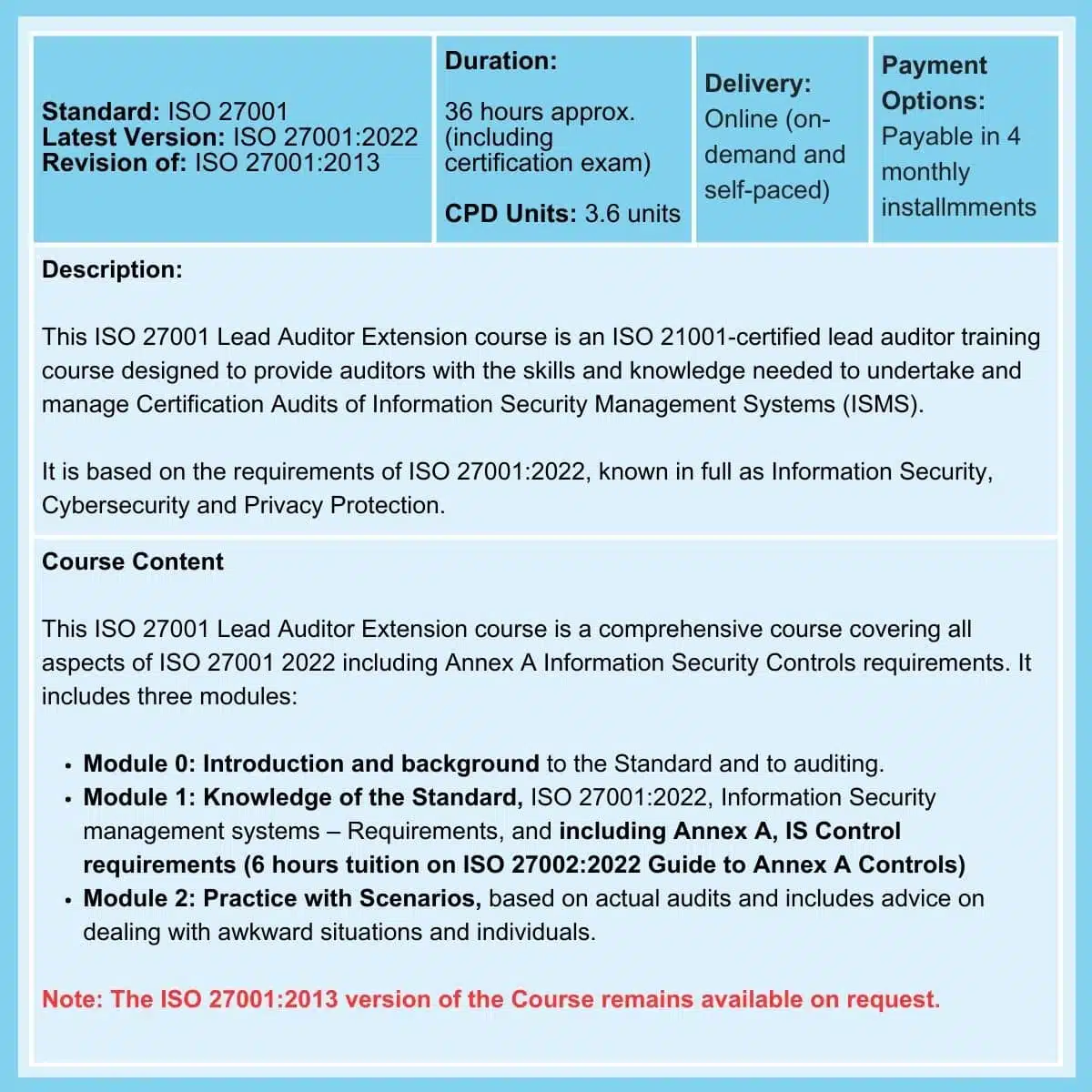
This comprehensive ISO 27001 Lead Auditor Conversion course is divided into three Modules:- Module 0: Introduction and background to the Standard and auditing - Explore ISO 27001:2022 and its implications for leading audits of information security management systems. Understand how lead auditors guide organizations through certification readiness and ISMS compliance.
- Introduction to ISO 27001:2022 - Examine the updated ISO 27001 framework and its impact on lead auditing activities. Key changes include a stronger emphasis on risk-based thinking, alignment with ISO 27002:2022, and revised Annex A control categories.
- Terms & Definitions – ISO 27001 - Clarify updated terminology relevant to lead auditors and ISMS assessment. Focus on definitions for risk treatment, interested parties, and information asset management.
- Fundamentals of Information Security Management Systems (ISMS) - Assess ISMS structure and operations to plan and lead audits effectively. Changes in 2022 emphasize the integration of information security into organizational processes and lifecycle management of assets.
- Some Key Aspects of ISMS Auditing - Apply audit principles to complex ISMS environments. Highlight evidence-based evaluation, management review verification, and control assessment under ISO 27001:2022.
- Structure & Content of ISO 27001:2022 - Analyze the revised clauses and Annex SL structure to guide audit scope and methodology. Notable update: Annex A controls now use four themes (Organizational, People, Physical, Technological) instead of 14 domains.
- Part 4: Context of the Organisation - Evaluate internal and external factors affecting the ISMS. The 2022 standard emphasizes assessing organizational context, stakeholder expectations, and relevant regulatory requirements for audit planning.
- Part 5: Leadership - Examine top management roles and accountability in ISMS implementation. Lead auditors focus on verifying leadership commitment, resource allocation, and risk governance.
- Part 6: Planning for the ISMS - Assess risk management and planning processes under ISO 27001:2022. Include evaluating risk treatment strategies, control selection, and alignment with organizational objectives.
- Information Security Risk Assessment - Lead audits to evaluate risk identification, estimation, and evaluation techniques. Consider threats to data integrity, availability, and confidentiality in information security contexts.
- Guidance to Risk Analysis - Review methods for analyzing and prioritizing risks in complex ISMS environments. Include evaluating likelihood, impact, and residual risk reporting.
- Risk Identification / Risk Estimation / Risk Evaluation - Verify that organizations properly identify assets, threats, and vulnerabilities. Assess how they quantify risks and prioritize treatment based on ISO 27001 guidance.
- Information Security Risk Treatment - Audit risk treatment plans and confirm they align with Annex A controls. Include evaluating technical controls, policies, and mitigation strategies.
- Information Security Objectives and Planning to Achieve Them - Examine how organizations define measurable ISMS objectives and track progress. Examples include incident response improvements, network protection, and employee awareness programs.
- Part 7: Support - Audit ISMS support processes, including resources, competence, awareness, and communication. Focus on documentation management, training programs, and internal communications of security roles.
- Part 8: Operation - Evaluate operational ISMS activities and implementation of controls. Key 2022 updates emphasize process-driven operations, supply chain security, and continuous monitoring practices.
- Part 9: Performance Evaluation - Assess ISMS performance using audit findings, metrics, and management reviews. Review trend analysis and evaluate the effectiveness of implemented information security controls.
- Part 10: Improvement - Audit continual improvement processes within the ISMS. Include actions to address IS incidents and other nonconformances, revising risk treatment plans, updating controls, and integrating lessons learned from incidents.
- Advanced Aspects of ISMS Auditing - Lead audits in complex, multi-site ISMS environments. Cover sampling strategies, remote auditing techniques, and integration with other management systems.
- FAQs about the Standard - Clarify common challenges for lead auditors under ISO 27001:2022. Include guidance on updated Annex A controls, risk-based auditing, and reporting findings effectively.
- ISO 27002:2013 – Security Techniques: Code of Practice for IS Controls - Review the implementation of ISO 27002 controls to strengthen ISMS practices. Focus on access control, cryptography, physical security, and operational safeguards.
- ISO 27006:2015 – Requirements for IS Certification Bodies - Understand certification body requirements to ensure audits meet ISO 27001:2022 compliance expectations. Include audit planning, review protocols, and reporting standards.
- Online Module Examination - Demonstrate proficiency in leading ISO 27001:2022 audits, evaluating ISMS performance, and verifying information security controls.
- Module 2: Practice with Scenarios
- Audit Scenarios – Internal Auditor / Lead Implementer / Lead Auditor - Apply lead auditor techniques to real-world ISMS challenges. Include multi-role scenarios, risk-based audit approaches, and stakeholder management.
- FAQs about the Auditing Experience - Integrate lessons from practical audit exercises, including ISO 27001:2022 updates. Focus on handling challenging situations and ensuring effective ISMS compliance.
- Online Final Examination - Test ability to conduct ISO 27001:2022 lead audits, assess ISMS performance, and provide actionable recommendations. Include evaluating control effectiveness and reporting to management.
What materials are included in this ISO 27001 Lead Auditor Conversion Course?
The course materials for this ISO 27001 Lead Auditor Conversion course include:- Diagram: Auditor Certification Process
- Diagram: 6-Stage Audit Process
- Sample Code of Ethics
- Management of an Audit Programme
- Audit Plan example
- Audit Work Order example
- Nonconformity Report example
- Documented information in ISO 27001
- EU GDPR Full text
- Note: Information Assets
- Information security risk management process
- Information security risk treatment activity
- Chart of ISO 27001 Internal and External COTO Issues
- Stage 1 ISO 27001 Checklist of Critical Issues
- Stage 1 ISO 27001 Lead Auditor Checklist
- Sample Info Assets, SoA Risk Assessments, and Controls
- Sample Statement of Applicability
- Workbook for Annex A (SoA) Evidence recording
How is this ISO 27001 Lead Auditor Conversion Course delivered?
The Course is delivered online from our Learning Management System (LMS), which is provided and maintained by Inquisiq, the Award-winning Learning Management System. All Lessons have a full resume and scaling capabilities. This means, for example, you can:- Start a Lesson at work on your Work Station running on Windows 11,
- Continue the Lesson on the train home on your iPad running on iOS 15 and,
- Complete the Lesson at home on your Notebook PC running on Windows 10.
Are there any prequalifications to enroll in this ISO 27001 Lead Auditor Conversion Course?
The minimum of a Secondary School Certificate (such as a High School Diploma, Baccalaureate or similar National Vocational Qualification) combined with 5 years’ work experience, with 2 at managerial/supervisory level, is recommended. You do not have to provide us with any evidence of your qualifications and experience. However, if you do not meet these requirements, you can expect to struggle with this course.
Related Courses
Free Gap Analysis Tool
Identify systems or process gaps in your management system that can be improved with our ISO 13485 Gap Analysis tool.
Sample Learner Certificate

deGRANDSON Global certificates issued to learners who successfully completed the training and passed the certification exam come with QR codes that can be shared on online profiles to instantly verify qualification to prospective clients or employers.